
Welcome to Karlstad University




News
-
2026-11-09
Honorary doctor 2027 wants to build a more resilient society
Society’s ability to address complex societal risks has been the driving force throughout Thomas Gell’s career. How can accidents and societal disruptions be prevented? Thomas Gell has contributed to establishing and developing societal risk management as an interdisciplinary academic field at Karlstad University, while also creating lasting structures for collaboration between research, education, government agencies and rescue services. For these contributions to both academia and society, he is awarded an honorary doctorate by Karlstad University in 2027.
Risk management is a highly relevant field today, but as early as the beginning of the 2000s, initiatives were taken to establish a professorship funded by the Swedish Rescue Services Agency, creating the organisational and financial conditions necessary for academic investments at Karlstad University. Through research collaborations, staff exchanges and doctoral education for government employees, Thomas Gell has built enduring links between academia and practice through the Master's Programme in Risk Management in Society and the Centre for Societal Risk Research.
-
2026-11-09
Sustainability Day 2026
Students, colleagues and everyone with an interest are warmly welcome to Sustainability Day 2026 at Karlstad University, a hybrid event hosted by Karlstad Business School and the Service Research Center (CTF).
This year's theme, The Sustainable Community: From Everyday Services to Resilience in Crisis, looks at how the premises and environments we use in everyday life can also give society capability and resilience in times of crisis. "A shelter that only opens once a crisis has already struck is somewhere we first have to find and get to know.
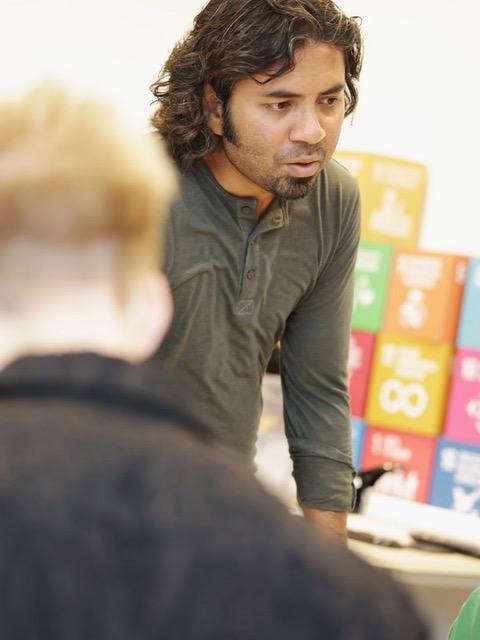
– The environments that work best when something unexpected happens are often the places we already know, use and feel safe in, says Samuel Petros Sebhatu, Associate Professor of Business Administration and moderator of the day.
-
2026-11-05
Is “good job” the right or wrong kind of praise?
Praise influences employees’ intrinsic and extrinsic motivation and their sense of pride. But how should managers give praise so that it is received positively? And how should the expression “good job” be used? Research from Karlstad Business School sheds light on these questions.
Receiving praise from a manager after a successful effort at work can certainly feel rewarding. But what should managers consider when commenting on an employee’s performance? Sven Siverbo, Professor in business administration at Karlstad Business School, has conducted research on these issues.
The research resulted in three articles:
-
2026-11-04
SEK 36.5 million awarded to Karlstad University researchers
Several research funding bodies make their funding decisions during the autumn. So far, eight applications from researchers at Karlstad University have been awarded a total of SEK 36.5 million.
The Swedish Research Council, Sweden’s largest governmental research funding body, has awarded funding from its educational sciences programme to the project “Boys’ Reading Engagement: Place-Sensitive Reading Instruction in Upper Secondary Vocational Education”. The project is led by Stig-Börje Asplund, Professor of Educational Work at the Department of Educational Studies, and has been awarded SEK 3,899,000.
-
2026-11-03
Crisis management exercise at Karlstad University on 19 November
The police and other emergency response agencies will conduct an exercise at Karlstad University, in and around Building 12. In connection with this, the university will carry out an internal crisis management exercise to test new working methods and strengthen its ability to handle serious incidents.
The exercise will be clearly communicated and marked. Among other measures, building 12 will be cordoned off during parts of the day. Affected departments and units have already been informed. Students will be informed via kau.se, social media channels, and information screens across campus.
-
2026-11-02
Students want clear answers about AI
Students are often accustomed to using AI in their everyday lives. However, when they begin university, new questions arise. Is it permitted to use AI? Where is the boundary between acceptable use and cheating? Do I need to disclose that I have used AI? Can I trust the answers it provides?
Many students turn to the University Library for guidance. They are looking for clear rules and want to ensure they are doing the right thing, say the librarians, who have compiled the most common questions into seven categories.
The boundary between language support and content generation
Questions in this category concern whether it is acceptable to use AI to improve language, translate text, or make writing more academic.