In an era marked by so-called polycrises, where climate change, energy challenges, economic uncertainty, and global conflicts influence and reinforce one another, societal resilience is becoming increasingly important. During A Sustainable Tomorrow, it was emphasized that resilience is not only about technology, stockpiles, and contingency plans.
Equally important is the ability of people and organizations to collaborate, share resources, and adapt their ways of working as circumstances change. The foundation of a resilient society is built in everyday life.
– Throughout the day, we were presented with different perspectives on resilience, both in terms of its definition and our understanding of the concept, says Helén Williams, Associate Professor of Environmental and Energy Systems at the Service Research Center (CTF). We attended a presentation by Lisen Schultz from the Stockholm Resilience Centre, who shared their work on the nine ‘Must-Knows’ that summarize key insights about resilience.
The results of Schultz’s work are intended to help decision-makers understand and strengthen resilience in a world characterized by increasing uncertainty, change, and interconnected crises. One of these “Must-Knows” focuses on resilience through learning and innovation, emphasizing continuous learning, reassessment, and experimentation. Another highlights the agency of individuals and institutions, meaning that people need the opportunity, knowledge, and mandate to act, adapt, and contribute to change when circumstances shift.
– Another presentation was given by Isabelle McAllister and Emma Westerlund, focusing on educating for the unknown, says Helén Williams. They were critical of the way education is currently structured and argued that we are not preparing today’s young people for the societal transition ahead.
They presented several ideas for courses and academic programs they would like universities to offer, such as a Degrowth Course, a What Must Die? Course, or even a Faculty of Uncertainty.
Fredrik Reinfeldt concluded A Sustainable Tomorrow with a global overview and reflections on why the world seems unable to function effectively at present. His overarching explanation was that global power is concentrated among men in their seventies and eighties who, in his view, are often irritable, narcissistic, and driven by imperial ambitions, making them ill-equipped to meet the challenges of governing an increasingly complex world.
A workshop was also conducted during A Sustainable Tomorrow. How did participants experience it?
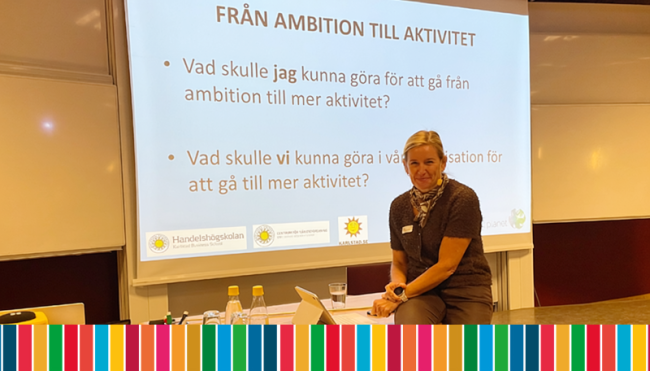
– Participants were invited to reflect on the presentations and discuss in groups how they themselves could move from ambition to action, and what their organizations could do to strengthen resilience efforts, says Helén Williams.
The participants felt it was valuable to collectively connect the insights from the presentations on resilience to their own organizations and daily work. They identified a need for greater collaboration across functions and areas of expertise, recognizing that many vulnerabilities cannot be addressed within a single part of an organization.