
Geomedia speaker series - The Personal superintelligence frontier: an anticipatory research agenda
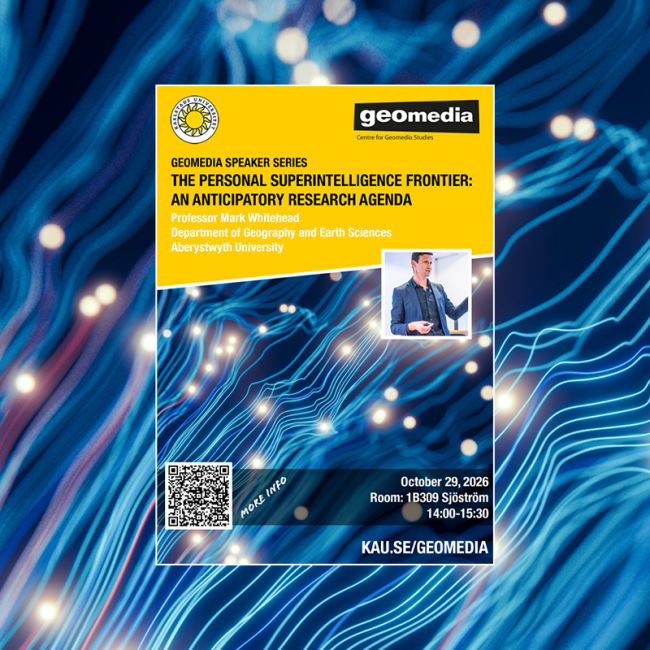
Professor Mark Whitehead, Department of geography and earth sciences, Aberystwyth University
- Karlstad University
- October 29, 2026
- Room: 1B309 Sjöström
- 14:00-15:30
Our lives our currently saturated by the claims and counterclaims swirling around Artificial Intelligence. Caught within contemporary existential debates about the empowering potential of “abundant intelligence” and daily risk assessments of potential human extinction, it has been easy to miss what is perhaps one of the most significant developments in the technological trajectory of AI. In 2025 Meta outlined its vision of personal superintelligence.
From a technical point of view, personal superintelligence is pitched as an AI-based personal assistant (the goal of developing personalised AI assistants is now common within the sector). Unlike centralised models, which may be trained for societal problems in environmental and medical science (among more ambiguous goals), personalised superintelligence is focused on individual human subjects and their daily needs.
It is claimed, by companies such as Meta and Open AI, that the personalisation of Artificial Intelligence can reduce the cognitive load of our busy and complicated lives, improve the effectiveness of our decision-making, uncover greater efficiencies in our routines, enable us to become better friends and colleagues, and empower us to more consistently achieve our short and long-term goals. While the form factor of personalised superintelligence is still to be settled upon, it is clear that glasses are Meta’s preference.
Due to its potential to technologically automate the most intimate aspects of our private lives, some see personal superintelligence as the unofficial finish line of the AI industry. This paper outlines the nature and justificatory logics behind the promotion of personal superintelligent agents, drawing particular attention to claims of technological decentralisation, personalised AI alignment, and the balancing of digital power. As a basis for anticipatory research into this emerging technology, analysis will then set out a critical framework for the interpretation of personal superintelligence.
In part this will focus on long-held concerns over digital privacy and surveillance. But analysis will also introduce more novel concerns related to “cognitive deregulation” and the anthropological and moral visions encoded within the personal superintelligence movement.
Mark Whitehead is a Professor of Geography at Aberystwyth University in Wales. His previous work has explored various aspects of behavioural governance and smart-technology. He is a Fellow of the Independent Social Research Foundation and Co-Editor of the journal Humanities and Social Science Communications. He is currently completing a Leverhulme Research Fellowship exploring personal superintelligence.