Geomedia Speaker Series
Geomedia Speaker Series är en serie föreläsningar och workshops som tar utgångspunkt i det tvärvetenskapliga fältet geomediastudier, dvs. överlappningen mellan medie- och kommunikationsvetenskap och kulturgeografi. Internationellt tongivande föreläsare från olika discipliner bjuds in för att hålla en öppen föreläsning och medverka i en tematisk workshop med Geomedias forskare, doktorander och andra intresserade. Våra evenemang arrangeras både på plats och digitalt via nätet.
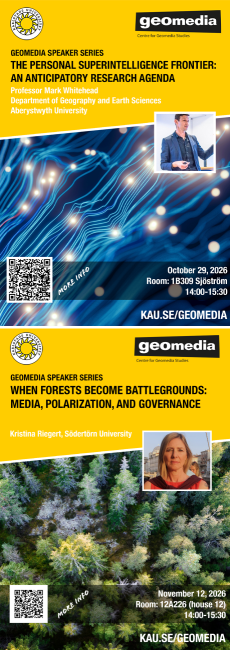
GEOMEDIA SPEAKER SERIES: The Personal Superintelligence Frontier: An Anticipatory Research Agenda
Professor Mark Whitehead, Department of Geography and Earth Sciences, Aberystwyth University
- Karlstad University
- October 29, 2026
- Room: 1B309 Sjöström
- 14:00-15:30
Our lives our currently saturated by the claims and counterclaims swirling around Artificial Intelligence. Caught within contemporary existential debates about the empowering potential of “abundant intelligence” and daily risk assessments of potential human extinction, it has been easy to miss what is perhaps one of the most significant developments in the technological trajectory of AI. In 2025 Meta outlined its vision of personal superintelligence.
From a technical point of view, personal superintelligence is pitched as an AI-based personal assistant (the goal of developing personalised AI assistants is now common within the sector). Unlike centralised models, which may be trained for societal problems in environmental and medical science (among more ambiguous goals), personalised superintelligence is focused on individual human subjects and their daily needs.
It is claimed, by companies such as Meta and Open AI, that the personalisation of Artificial Intelligence can reduce the cognitive load of our busy and complicated lives, improve the effectiveness of our decision-making, uncover greater efficiencies in our routines, enable us to become better friends and colleagues, and empower us to more consistently achieve our short and long-term goals. While the form factor of personalised superintelligence is still to be settled upon, it is clear that glasses are Meta’s preference.
Due to its potential to technologically automate the most intimate aspects of our private lives, some see personal superintelligence as the unofficial finish line of the AI industry. This paper outlines the nature and justificatory logics behind the promotion of personal superintelligent agents, drawing particular attention to claims of technological decentralisation, personalised AI alignment, and the balancing of digital power. As a basis for anticipatory research into this emerging technology, analysis will then set out a critical framework for the interpretation of personal superintelligence.
In part this will focus on long-held concerns over digital privacy and surveillance. But analysis will also introduce more novel concerns related to “cognitive deregulation” and the anthropological and moral visions encoded within the personal superintelligence movement.
Mark Whitehead is a Professor of Geography at Aberystwyth University in Wales. His previous work has explored various aspects of behavioural governance and smart-technology. He is a Fellow of the Independent Social Research Foundation and Co-Editor of the journal Humanities and Social Science Communications. He is currently completing a Leverhulme Research Fellowship exploring personal superintelligence.
----- -----
GEOMEDIA SPEAKER SERIES - WHEN FORESTS BECOME BATTLEGROUNDS: MEDIA, POLARIZATION AND GOVERNANCE
Kristina Riegert, Södertörn University
- Karlstad University
- November 12, 2026
- Room: 12A226 (house 12)
- 14:00-15:30
Societies today face two interlinked and urgent challenges: implementing a green transition towards sustainability and preserving democratic legitimacy at a time of declining trust in institutions, science, and journalism. In the age of climate change and biodiversity loss, forests in Sweden have become the subject of heated media debates.
These debates often reflect tensions between multiple forest values, among them the economic use of forests versus ecological functions such as carbon storage and biodiversity protection. The media amply and co-structure the debates and can enable particular interests to shape what the conflict is about.
One example of this is the acrimonious debates related to the Church of Sweden’s forest inquiry, where competing frames structured problem definitions and plausible solutions. Rather than tempering disagreement, these framings accentuated polarization by amplifying adversarial cues and narrowing attention to win-lose stakes. This also had real-world consequences for the recent church election, where green parties gained ground. In forest-climate debates, journalism is also important – journalists negotiate credibility, authority, and relevance.
Our research on Nordic journalists covering “green conflicts” shows how reporters embedded in conflict-affected communities face intense audience feedback and perform substantial emotional labour, which may lead to focusing on episodic citizen–politics disputes rather than the broader climate dimension of the conflict.
Forest–climate debates hinge on contested evidence and values. It is therefore important to examine how scientists participate as sources, explainers, and interlocutors in legacy and social media and how this shapes journalistic practice and citizens’ capacity to reason across disagreement. Research ultimately needs to illuminate the dynamics of mediated conflict to understand how discursive power in forest-climate issues is achieved in order to provide insight into democratic deficits.
Kristina Riegert is Professor of Journalism at Södertörn University (Stockholm). Her work examines how national and transnational media make sense of globally mediated events, in crisis and conflict journalism, as well as how the political infuses popular culture and cultural journalism.
Current work is related to media framing of forest–climate debates in the Baltic Sea region at a time of increasing polarization and disputed governance around forests. Her books include Politicotainment: Television’s Take on the Real and Kulturjournalistikens världar (co‑edited), alongside articles in leading communication and journalism journals.
---- ----
GEOMEDIA SPEAKER SERIES SPACES OF (IN)VISIBILITY: PERCEPTION, INFRASTRUCTURE, LANDSCAPE - ONLINE SEMINAR
Crispin Thurlow, University of Bern, Switzerland
2026 Ander Visiting Professor of Geomedia Studies, Karlstad University
- Karlstad University
- November 20, 2026
- Online
- 13:00-15:00
This two-hour, online panel brings together three different approaches to the question of how people, spaces and material formations are made perceptible or imperceptible, how presences/absences are produced and registered, and what relations of power are involved in these processes. After a short introduction by the host, we will hear from Prof. Dr Don Kulick (Uppsala), then Dr Natalia Volvach (Gothenburg), and then Dr. Alessandro Pellanda (Bern). The panel will close with a short plenary discussion between the invited speakers along with other attendees.
Invited speakers
Don Kulick
People Who Aren’t Really There
Don Kulick will present the theoretical underpinnings of ERC-financed “Out of Sight” project. I will discuss different approaches to social imperceptibility, which hinge on the distinction between willed and unwilled imperceptibility. Unwilled imperceptibility tends to be the focus of academic work, which documents people like refugees and highlights relations of power and oppression. Willed imperceptibility tends to be foregrounded in popular representations of people like fraudsters or imposters. What gets spotlighted there is often creativity, guile, and craftiness. I will argue that these different approaches have important consequences for how we think more generally about social imperceptibility and people Erving Goffman called “non-persons”.
Natalia Volvach
Sensing In/visibility: An Ethnography of Ghosts in Qırım-Crimea
This talk attends to spaces of (in)visibility during times of political upheaval as perceived through the researcher’s sensing body. Drawing on an extensive ethnography in Russia’s occupied Qırım-Crimea (Volvach, 2026) – following its occupation in 2014 but prior to the full-scale war in 2022 – I consider how violence reverberates and haunts the place (cf. Navaro et al. 2021). Unpacking the encounters with people, material environments, and lived spaces, the talk illuminates how ghosts reappear as another guise of violence, directing our attention towards the ‘dense site where history and subjectivity make social life’ (Gordon 2008, p. 8). Instances such as yanked-out plaques, overwritten inscriptions, discursive omissions, and material detachments in an occupied landscape are not merely indexing absence. Rather, and following Volvach & Kerfoot (2026), these traces acquire an affective charge: they testify to violent acts of erasure and ideological redesign, affect the researcher, and continue to speak to those who sense them.
Alessandro Pellanda
Built to be Seen, Designed to Disappear: Toward a Semiotics of Spectacular (In)visibility
In this talk, I introduce the concept of spectacular (in)visibility: an ongoing and active semiotic process in which the hyper-visible performance of order continually generates the invisibility of its own material underpinnings. Grounded in my doctoral dissertation on Swiss waste governance, the concept reveals how seemingly mundane technologies and infrastructures of waste management become key semiotic landscapes (Pellanda, 2025). These landscapes calibrate the organization of visibility, so that Switzerland’s own material reality remains unseen, or displayed only under precise conditions. I trace this calibration across two sites: the waste-to-energy plant, whose architectural visibility is precisely what allows the material process of incineration to remain unseen, and the official, color-coded garbage bag, a smaller but equally deliberate object of design. In both cases, multimodal rhetorical tactics – architectural, discursive, and material – negotiate the visibility and invisibility of waste (Pellanda, 2026). Ultimately, I show how this concept extends well beyond the domain of waste management, offering a way of reading infrastructural governance more broadly.
This event is sponsored by the Center for Geomedia Studies at the University of Karlstad. Access is open to all. For the necessary Zoom link, please send a request to Prof. Dr. Cornelia Brantner