Study Programme in Innovation and Design Engineering
180 ECTS credits
Study programme
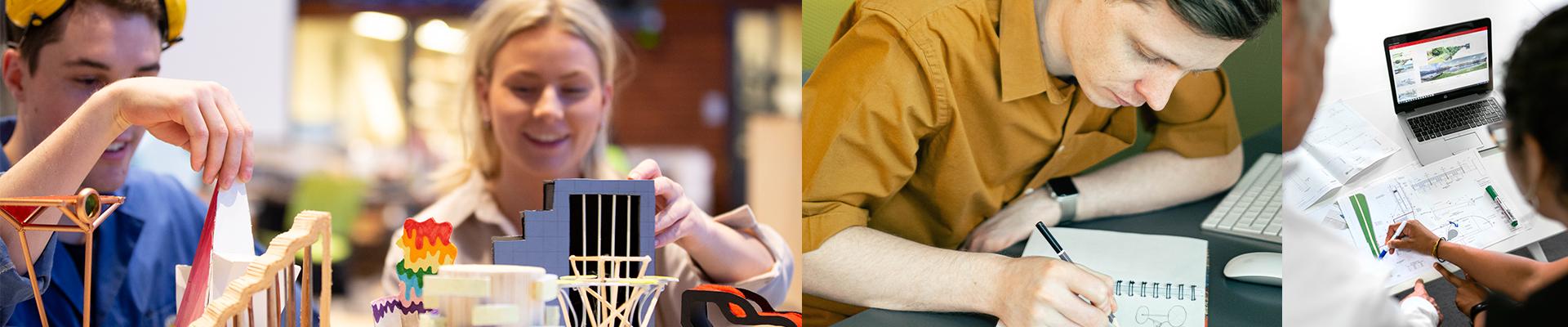
The programme in innovation and design engineering is characterized by a holistic perspective on the product development process. This perspective is based on industrial designers' ways of solving problems with the help of design thinking. Add to this technical competence, creativity, and your own curiosity. As an innovation and design engineer, you will work with the entire product development process, from the identification of a need, via ideas, sketches, and models, to a prototype and the finished product.
Education level:
Basic level
Prerequisites
General admission requirements + Physics 2, Chemistry 1, Mathematics 3c /Mathematics D
While studying
Education
The Innovation and Design Engineering program provides you with a broad skill set, combining the industrial designer’s approach to problem-solving through design methodology, creativity, and curiosity with the technical expertise of a mechanical engineer. As a design engineer, you will work across the entire product development process—from identifying needs, generating ideas, sketches, and models to creating prototypes and finished products. Altogether, this gives you a solid foundation for technical innovation capabilities.Your design skills are developed through courses in design methodology, design and innovation theories, human thinking, creativity processes, sketching techniques, form theory, ensuring products convey the right message, model building, digital tools, and various visualization methods—all within a holistic perspective on sustainability.
Your technical skills developed in courses in mathematics, mechanics, solid mechanics, materials engineering and construction and energy technology.
Design expertise built through courses in design methodology, human thinking, creative processes, drawing techniques, color and morphology, the products give the right message, modeling, and various visualization methods.
You will study courses provide a basic knowledge of mechanical engineering, energy and environmental engineering, and mathematics. You will also be trained in working in projects and in presenting your results in speech and in writing. In addition, you will learn about the role of technology in society.
In the second year, you take courses that are specific for this programme. They provide knowledge that is of a creative, innovative, design-oriented, and visual nature, including theories of human thinking and culture, and knowledge of how to create concrete products, with an emphasis on innovation, design, production, construction, choice of materials, and manufacturing.
In the third year you may choose to study a course on service design and graphical design. There will also be a course on integrated product development, which is an important concept implying that everybody participating in the product development process works in a team in order to develop products in a faster and safer way. The programme ends with a degree project. This project is a practical and realistic application of previous courses and will be carried out in close cooperation with a company.
Form of Instruction
The training is full-time study and teaching is in the form of lectures, tutorials and laboratory sessions, workshops as well as projects under supervision.Examination
There are no set examination periods, and generally no final exam at the end of a semester, an academic year, or a complete study programme. Examination usually takes place at the end of each course, module, or unit.Study Abroad
The opportunity exists to fulfil a part of the study requirements abroad, e.g. in the elective part of the programme. Karlstad University participates in exchange and cooperation programmes with universities and university colleges in many countries in Europe and further afield.Professional Contact
The programme takes place in close cooperation with private enterprise through special project assignments in different courses.Course of study
| Semester 1 | ECTS credits |
|---|---|
| Introduction to Innovation and Design Engineering at Bachelor level (Obligatory) | 7.5 |
| Mathematics for Engineers I (Obligatory) | 7.5 |
| Introduction to programming and data processing (Obligatory) | 7.5 |
| Mechanics 1: statics (Obligatory) | 7.5 |
Total ECTS credits:
30
| Semester 2 | ECTS credits |
|---|---|
| Manufacturing Technology 1 (Obligatory) | 7.5 |
| Fundamental Energy Technology (Obligatory) | 7.5 |
| Mathematics for Engineers II (Obligatory) | 7.5 |
| Materials Engineering, basic course (Obligatory) | 7.5 |
Total ECTS credits:
30
| Semester 3 | ECTS credits |
|---|---|
| Mechanics 2: dynamics (Obligatory) | 7.5 |
| Electrical technology (Obligatory) | 7.5 |
| Solid Mechanics I for Bachelor students in engineering science (Obligatory) | 7.5 |
| Design and innovation theories (Obligatory) | 7.5 |
Total ECTS credits:
30
| Semester 4 | ECTS credits |
|---|---|
| Communication Tools for Industrial Design (Obligatory) | 7.5 |
| Machine components (Obligatory) | 7.5 |
| Production Systems I (Obligatory) | 7.5 |
| Machine design I, Study Programme in Engineering (Obligatory) | 7.5 |
Total ECTS credits:
30
| Semester 5 | ECTS credits |
|---|---|
| Visual Thinking and Design (Obligatory) | 7.5 |
| Ergonomics (Obligatory) | 7.5 |
| Sustainable Product Development (Obligatory) | 15 |
Total ECTS credits:
30
| Semester 6 | ECTS credits |
|---|---|
| Design processes in theory and practice (Elective) | 7.5 |
| Production Systems II (Elective) | 7.5 |
| Degree Project for Bachelor of Science in Innovation and Design Engineering (Obligatory) | 22.5 |
| Machine design II (Elective) | 7.5 |
Total ECTS credits:
30*
*Full-time study always equals 30 ECTS credits per semester (20 weeks).
Program evaluations
Start semester Autumn 2021
Start semester Autumn 2020
Start semester Autumn 2019
Start semester Autumn 2018
Start semester Autumn 2017
Future prospects
Employment Market
Depending on your interests, you may find yourself designing together with industrial designers, e.g. as an employee or consultant in development projects at industrial production companies. In minor manufacturing companies, you can contribute with modern methods for quick and effective product development, thereby enhancing competitiveness. With your own innovations, and the tools to assess factors related to economy, marketing, production, and society, you will even be equipped to start your own businesses.Degree
This programme leads to a university degree in Innovation and Design Engineering corresponding to 180 ECTS credits.Further Studies
The education is part of the new flexible education structure in Europe. With your degree you can, provided that you have the necessary mandatory courses, continue your studies aiming for a masters degree in computer science, either at Karlstad University or at other universities in Europe. Studies at the advanced level make you eligible for doctoral studies.Tuition fees
- Total fee: 450,000 SEK
- Per semester / First payment: 75,000 SEK
You do not have to pay tuition fees if you are an exchange student or a citizen of a country within the European Union (EU), the European Economic Area (EEA), or Switzerland.