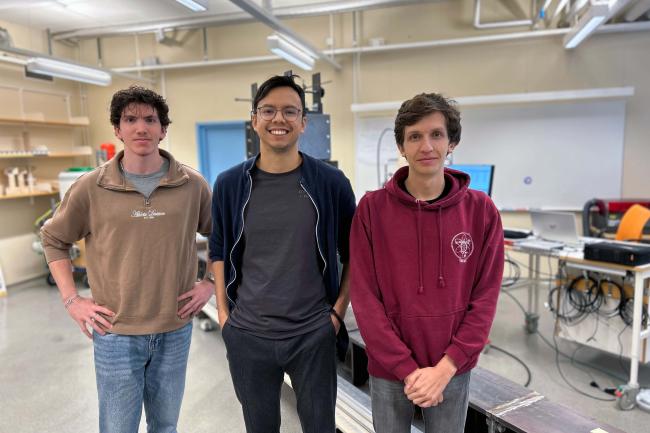
How can recycled wood fibres be used to create sustainable construction materials that also store carbon for long periods of time? This is one of the questions being investigated by two exchange students from France.
Aylal Gaultier and Robin Grandzinski are engineering students at Supmicrotech in France. They are spending six months at Karlstad University through an international collaboration led by Marcus Vinícius Tavares da Costa, Assistant Professor of Building Technology.
“Supmicrotech is a French higher education institution that trains engineers, and we would like to strengthen our collaboration with them. Aylal and Robin are currently studying here as exchange students, and we hope to welcome more students to Building Technology in the future,” says Marcus Vinícius Tavares da Costa.
Getting a Taste of Research
“As part of our degree programme, we are required to spend at least five or six months abroad, either as exchange students or interns. We saw this as an opportunity to come to Sweden and at the same time gain experience of research, as neither of us had worked in research before,” says Robin Grandzinski.
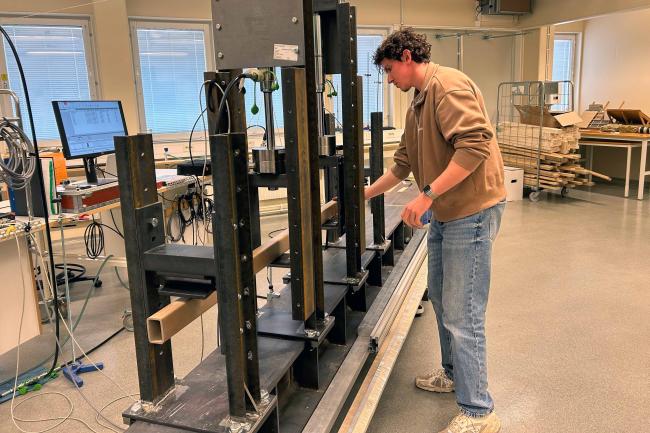
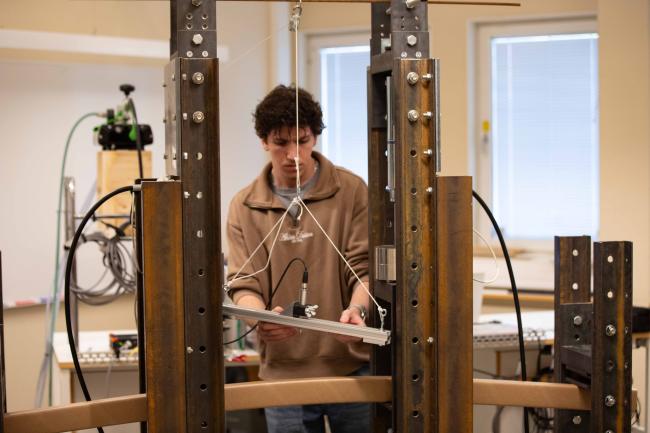
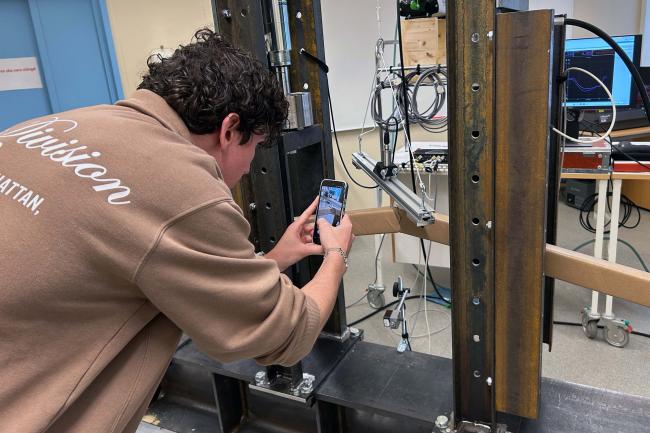
During their stay, they are taking part in experimental testing and evaluation of fibre-based construction components. An important aspect of the work involves investigating how different material solutions affect the strength of paper-based structural products.
“We carry out four-point bending tests and can monitor on a computer how the materials behave under load. We continue applying force until they either crack on the tension side or fails in compression,” says Aylal Gaultier.
Giving Recycled Fibres a Longer Life
The project, funded by the Åforsk Foundation, aligns with the ambitions of the Pro2BE research environment and focuses on climate-smart construction solutions based on recycled fibres.
Today, a large proportion of the wood fibres that are not used as structural timber are turned into products such as packaging, newspapers and hygiene products. Although these fibres can be recycled several times, the carbon they contain eventually returns to the atmosphere when the materials are incinerated or decompose. By instead using the fibres in long-lasting construction products, the carbon can be stored for a considerably longer period.
The students and researchers are investigating paper-based studs, moulded fibre materials and other building components that could, in the long term, replace more carbon-intensive materials such as steel and concrete in certain applications.
For the placement students, the project provides both an introduction to research and an opportunity to contribute to the development of the bio-based building materials of the future.
“Sweden is one of the most obvious countries to come to for this type of research,” says Aylal Gaultier.
“The forestry industry is, particularly in Sweden, an important sector, and timber could be used as an alternative to concrete and reinforced steel in some applications. These paper-based studs are not like traditional timber; their structure is more similar to cardboard. As I understand it, they require less raw material, which is a potential advantage of this type of product,” says Robin Grandzinski.