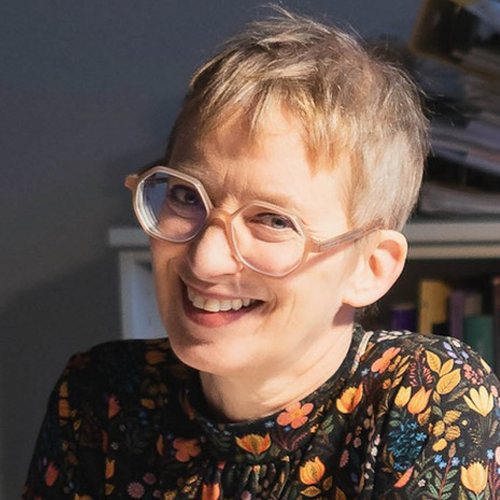
Maren Hartmann, professor in communication and media sociology, is the new Ander Visiting Professor at Centre for Geomedia Studies.
Maren, please tell us about your background
– My background is in a cultural studies version of media studies. This was formed when I went to the UK as an Erasmus student. After completing my PhD in media studies at Westminster University, I became a lecturer at Brighton University and later a researcher at the Vrije Universiteit in Brussels, Belgium. After other stops in Germany, I became a Junior Professor in communication and media sociology at the University of the Arts in Berlin. This is where I still am, trying to get inspiration in between from guest professorships in other parts of the world – like Karlstad.
How would you describe the field of Geomedia?
– I was attracted to Geomedia because it offered an intersection between media studies and something else. I had tried to combine the mobilities field with media studies in my work, but felt that media kept remaining an outsider there. So, a field that began as a combination with media was immediately attractive. Not only did mobilities seem to be positively subsumed here, but Geomedia generally maps nicely onto, or into, questions of place and space, of movement, of infrastructures and materialities, but also of everyday life and questions of mediatization.
How did you come in contact with Geomedia at Karlstad University?
– I saw the call for contributions to the first Geomedia conference at Karlstad and had the pleasure of attending it. By that time, I had already met several important actors in the field – André Jansson, Magnus Andersson, Karin Fast and others. I had read a lot by Mimi Sheller, because I was working with mobilities studies at the time and she was a keynote speaker at that first conference. I have attended most Geomedia conferences since and also had the pleasure of being involved with some of the research projects at Karlstad University (e.g. as a board member), of presenting work together at conferences and of publishing together.
In what way is Geomedia important in your work?
– I am generally interested in people’s media appropriation processes. And these generally happen in close relation to 'geo‘-questions (questions of location and movement, of power relations in rural and urban environments, of the politics surrounding these, etc.). Generally, Geomedia helps me to formulate the right questions in my work. It serves as a constant reminder of the geographic and geopolitical nature of so much of our quotidian media and communication processes. Plus, much of the work published in the field really speaks to me.
Please tell us about Geomedia related work from your research
– My work in the last few years has focused on homelessness and digital media use. But I came to the topic through questions of mobilities and immobilities and the relationship between physical and social mobility. One cannot properly think about homelessness and engage with people currently experiencing homelessness without including questions of space and place, of politics of housing, but also of movement and provision and the whole question of homelessness cultures. Homelessness is clearly interlaced with geo-questions as I called them for lack of a better term.
And what are your expectations of joining Geomedia at Karlstad University?
– The easy answer would be that I am looking forward to seeing people again and actually having the time to exchange more in-depth than usually. I can finally ask what the outcomes of the 'Measuring mediatisation' project are (and especially how you measure that) and/or hear more about the post-digital and (anecdotally) compare Berlin and Karlstad. I am also very curious to meet new people who are currently working in Geomedia - and to potentially develop research ideas together. Having space to think and talk about it is probably the best summary of my expectations.