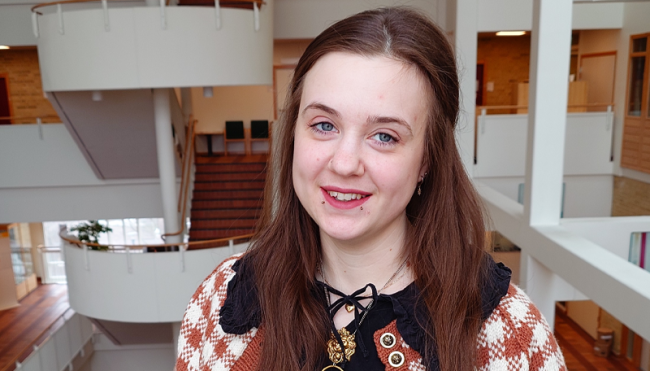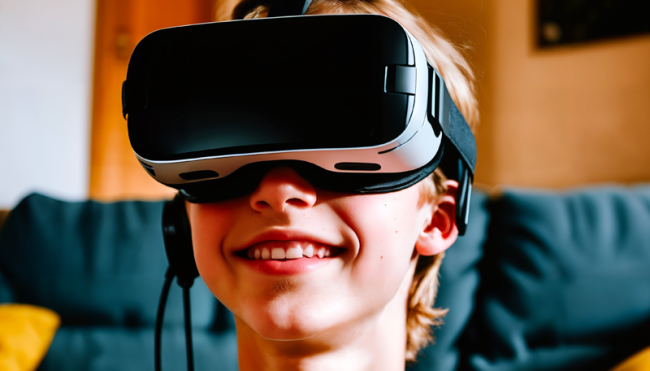
Immersion is the feeling of being absorbed in such a way that perception of the surrounding environment diminishes – as if you were transported elsewhere. Virtual Reality (VR) is often described as the ultimate immersive medium, since it shuts out the physical space for both sight and hearing. Linnea Saltin, newly minted PhD in cultural geography and affiliated with Geomedia, has researched the topic.
The feeling of losing track of time while scrolling on your phone is an example of how effectively digital technology can envelop us, while analogue experiences such as reading a book can also be highly immersive.
Linnea Saltin, what surprised you the most when you studied how people use VR at home?
– How differently people use and think about VR technology. There are many preconceived notions that VR headset users are only gamers, but people use their VR headsets to work out, travel, play, and relax. And it’s all kinds of people who want to explore the technology to see what place it might take in their lives.
Why is the home environment – the everyday space – so important for how we experience VR?
– New technologies often come with many myths – for example, that where we are will cease to matter, and that we will become independent of our physical location. These myths are especially prevalent with VR technology, which promises that you can open your eyes and find yourself somewhere else. VR technology is already widespread in society, in the military, industry, and medical settings. But using VR at home – which is an environment not designed to facilitate VR – makes it clear how access to the virtual space is dependent on the physical space. Your experience of being in the virtual is interrupted if you bump into the physical environment. The sensation of being in Virtual Reality can even become uncomfortable and dangerous if you don’t feel like you understand your position in the physical space – that your body and others who are present in the home are safe. As a VR user – even if you are partly elsewhere, you are still at home.
In your dissertation, “Ektopic: A Phenomenology of Domestic VR Usage in Sweden,” you challenge the idea that immersion is the core of the VR experience. What do we miss when we focus solely on immersion?
– We miss the obvious: that we do not disappear into the virtual in any way when we use VR – we remain in place. Much research on VR technology comes from technical and cognitive perspectives. It is about measuring immersion and improving it. If we compare this to reading a book, research would then only focus on how we become as absorbed as possible in the book, and which font and line spacing would get you into the story fastest. How does it work cognitively when you get hooked on a narrative? How little do we notice our surroundings when we read? Actually, we know that reading is a practice about much more than that—it organizes behaviors, spaces, and society. The same applies to VR technology; it reshapes our relationships, our homes, and our understanding of technology at a societal level and should not be reduced to the techno-social feeling of immersion.
Tell us about one of your findings
– A significant finding is that my respondents not only want increased immersion, but also ways to regulate their immersion and maintain contact with the physical space. It doesn’t feel safe to be completely enveloped by the virtual. People want to maintain a connection to physical reality.
You also introduce the concept of Ektopic emplacement – why is it important for understanding digital media?
– Ektopic is a Greek word meaning that something is placed outside a place. It refers to a position characterized by not being as it should be – something is off. I have taken the concept and extended it to describe the body’s position in the world when using immersive media. Ektopic emplacement means that we are here but not present. We are present somewhere else, but not quite there.
– I think many people recognize the feeling that technology and media increasingly make it unclear of our “hereness”. From trying to talk to your partner who is scrolling on their smartphone and is somewhere else, to someone using noise-cancelling headphones to be in Narnia via an audiobook on the bus. Technology increasingly blurs what presence in place means. But it also enables presence across distance.
What risks or limitations do you see in VR becoming normalized as everyday technology?
– It’s in the nature of VR technology that it is never really considered established. There are very strong cultural ideas about what society will look like once “VR is here.” Cyberpunk and dystopian science fiction have had a major influence on how we imagine VR and when we consider it to be a technology that truly “exists” for us. Those ideas and how technology normalize authoritarian politics, needs to be paid attention to.
How do you think our everyday places will change as digital and physical spaces increasingly merge?
– This is a change that is already underway. It’s as if our homes, workplaces, and spaces for leisure activities have acquired extra digital dimensions—for better and for worse. During the pandemic, we saw how the boundaries between rest, leisure, school, and work dissolved for those who were ordered to work from home. Much of this was enabled by digital solutions and digital places. In that sense, VR is simpler—you only need to navigate one virtual space and one physical space that are relatively bounded and defined. It is not the amorphous digitalization created by smartphones and social media.
What do you hope your research will contribute to the public debate on digitalization and everyday technology?
– I think we need to start taking people’s experiences and uses of new technology more seriously. We live in a time where there are strong narratives about technological development as something that happens to us, driven by tech giants with enormous power and little interest in human well-being and ethical issues. We need to be critical of this—but there are also inherent possibilities in people’s interactions with machines, in hopefulness and exploration.
The dissertation was defended on March 13 and was funded by the Centre for Geomedia Studies.