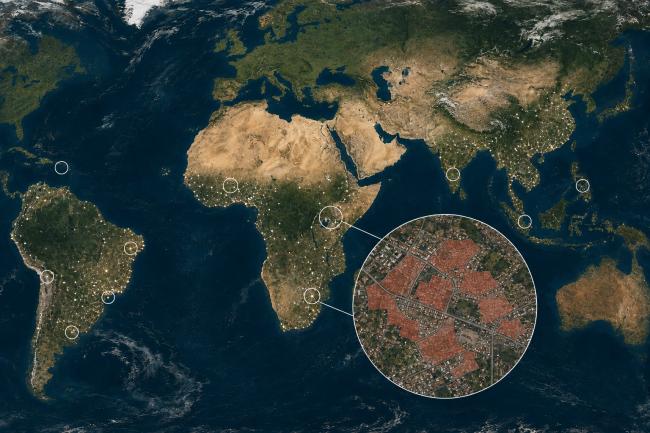
When urban challenges are discussed on the global stage, the spotlight often falls on megacities such as Mumbai, Lagos and Nairobi. However, a new study led by researchers at Karlstad University reveals that a substantial share of people living in disadvantaged urban environments are found in much smaller cities.
"The most important finding is that more than one-third of the people we identified live in small and medium-sized cities," says Sai Ganesh Veeravalli, PhD student in Risk and Environmental Studies/Geomatics at Karlstad University and lead author of the study.
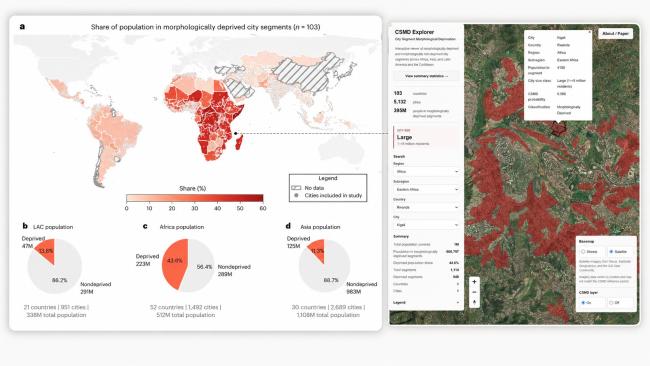
Published in Nature Cities, the study analysed 5,132 cities across 103 countries in Africa, Asia, and Latin America and the Caribbean. The researchers estimate that around 395 million people live in neighbourhoods characterised by dense built environments, smaller buildings, and limited road access – spatial patterns that can indicate disadvantaged urban conditions. Of these, approximately 136 million, more than one-third, live in small and medium-sized cities.
"Research on urban deprivation tends to focus on large metropolitan areas, but our findings show that a significant share of the challenge lies elsewhere," says Sai Ganesh Veeravalli.
Smaller Cities Often Remain Under the Radar
While the researchers expected to find disadvantaged neighbourhoods beyond the world's largest cities, the scale of the findings came as a surprise.
"We knew urban deprivation existed outside major cities, but we did not expect small and medium-sized cities to account for more than one-third of the affected population. What was equally striking was the lack of previous research to compare our findings with. That highlights a broader issue: many smaller cities remain largely underrepresented in global datasets and urban research," says Sai Ganesh Veeravalli.
According to the researchers, this can contribute to a self-reinforcing cycle. Smaller cities often have limited financial resources, less planning capacity and fewer technical experts than larger urban centres. At the same time, they receive less attention from researchers, policymakers and international development organisations.
"When less data is collected about these cities, it becomes more difficult to understand their challenges and target investments effectively. One of the motivations behind this study was to help break that cycle," says Sai Ganesh Veeravalli.
Open Geospatial Data and AI Offer a New View of Cities
To analyse thousands of cities in a consistent and comparable way, the researchers combined open geospatial datasets with machine learning and reference data derived partly from Earth Observation. Rather than measuring income or other socioeconomic indicators directly, the study examined the physical characteristics of neighbourhoods, including building density and size, plot structure, road networks and accessibility.
The researchers describe this as morphological deprivation – disadvantage reflected in the physical form and accessibility of urban neighbourhoods. It does not provide a complete picture of people’s socioeconomic conditions, but it can reveal spatial patterns that may otherwise remain difficult to identify at large scales.
The model was trained using reference data from eight cities where deprived and non-deprived urban areas had previously been mapped. It was then tested for its ability to transfer between cities before being applied to thousands of cities across multiple regions of the world.
"What makes this study unique is its scale and comparability. We were able to apply the same neighbourhood-level framework across more than 5,000 cities in 103 countries. Until recently, there was no common spatial framework that made this type of analysis possible," says Sai Ganesh Veeravalli.
A Tool to Support Better Decision-Making
The researchers emphasise that the study does not provide a definitive assessment of people’s living conditions. Instead, the maps are intended as a screening tool to identify areas where closer investigation and targeted interventions may be needed.
The data and maps have been made publicly available and can be used by municipalities, government agencies, NGOs, development organisations and researchers.
"The dataset can provide an initial overview of where urban deprivation may be concentrated. It should then be combined with local knowledge about infrastructure, housing, public services and climate-related risks. Our maps are not a substitute for local assessments, but a tool to support them," says Sai Ganesh Veeravalli.
Shifting the Focus Beyond Megacities
The researchers hope the study will contribute to a broader understanding of urban development challenges and encourage greater attention to smaller cities.
"If we are serious about achieving more sustainable cities and improving living conditions globally, we cannot focus exclusively on megacities. We also need to understand the realities of the small and medium-sized cities where millions of people live," says Sai Ganesh Veeravalli.
For Sai Ganesh Veeravalli, publication in Nature Cities also marks an important personal milestone.
"This is my first journal article as a PhD student, so having it published in Nature Cities is incredibly rewarding. More importantly, it reflects a genuinely collaborative effort involving researchers from several universities and countries. I'm especially pleased that both the paper and the underlying data are openly available, allowing others to use, test and build upon our findings."
The study is a collaboration between Karlstad University, Columbia University, the University of Twente, the University of Würzburg and the Public University of Navarra.
Read the article in Nature Cities: https://www.nature.com/articles/s44284-026-00498-w