In the special issue The Touristification of Work in the Post-Digital City, two major societal trends are brought together: the “touristification” of work and the “post-digital” city.
– The six articles in this issue explore how these dynamics are reshaping cities around the world, says André Jansson, Professor of Media and Communication at Karlstad University, who served as editor together with Karin Fast of Karlstad University and Magnus Andersson of Malmö University.
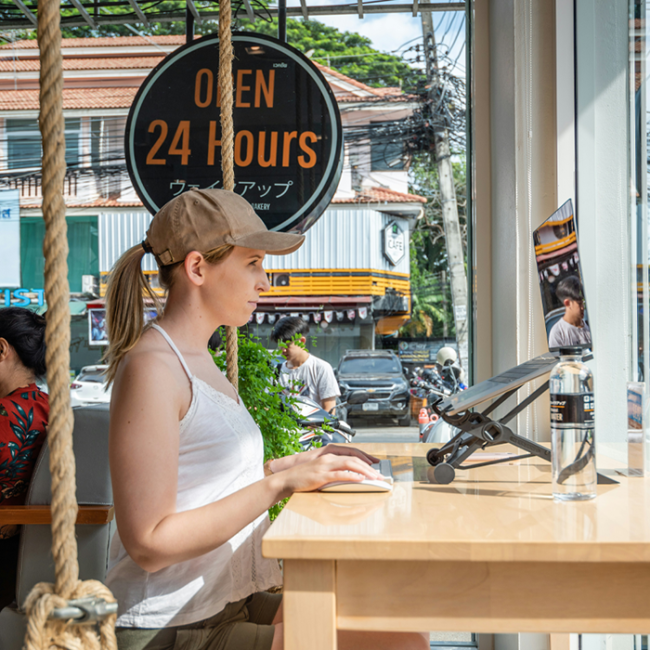
The title The Touristification of Work in the Post-Digital City encapsulates a dual societal trend: the touristification of work and the post-digital city. The touristification of work refers, among other things, to the rise of digital nomads and to new forms of office environments, such as coworking spaces, which are not merely practical workplaces but are increasingly packaged as relaxed lifestyle experiences resembling leisure travel.
– The post-digital concept refers to a contemporary zeitgeist in which permanent digital connectivity has become a taken-for-granted norm, generating a strong desire for analog counterbalances, craftsmanship, and digital disconnection, explains Karin Fast.
The six articles in the special issue investigate how these dynamics shape cities globally, from place branding in Barcelona and post-digital coworking environments in Sweden to the ways remote workers are transforming urban centers in the United States and rural areas in Italy.
– The issue is timely because it challenges the one-dimensional image of the flexible remote worker, says André Jansson. By combining media studies, sociology, and cultural geography, the research reveals how digitalization is transforming urban planning, local economies, and everyday life.
The articles demonstrate how cities and commercial actors are being forced to rethink their strategies as the boundaries between tourist and resident, and between work and leisure, increasingly collapse. The studies also reveal that the promised freedom of digital work often conceals new power structures in which cities are adapted to the needs of a mobile elite, while permanent residents and those without flexible jobs risk being marginalized.
What inspired you to dedicate a special issue to this topic?
– The special issue is based on the Swedish Research Council-funded project Hot Desks in Cool Places: Coworking Spaces as Post-Digital Industry and Movement, which we conducted between 2022 and 2025, says André Jansson. Our ambition has been to connect our findings with international research and broader trends that intersect with the themes we have studied. In this way, we are also building research networks that can generate future synergies, not least for Geomedia as a research center.
The research highlights findings from different parts of the world:
The city as an ambient office
In depopulated urban centers across the United States, planners are creating flexible environments where digital work and leisure coexist in cafés and public spaces to attract knowledge workers back to city centers.
Exclusive disconnection
Studies of Swedish coworking environments show that the right and opportunity to disconnect digitally has become an exclusive status symbol, primarily available to a mobile and digitally skilled elite.
Global inequality
Research from the Philippines demonstrates that the infrastructure developed for digital nomads creates deep social divides and reproduces global inequalities between foreign visitors and local residents.
How can this research be understood in a broader societal context?
– This research can be linked to ongoing debates about issues such as housing shortages, gentrification, and burnout in the aftermath of the COVID-19 pandemic, explains Karin Fast. A clear example is Barcelona, which actively incorporates coworking concepts into its city brand to attract digital nomads. When neighborhoods are adapted to meet the needs of short-term visitors seeking trendy cafés, artisan shops, and flexible office spaces, local communities are transformed. Prices rise, and permanent residents risk being displaced.
She adds that the issue is also connected to people's search for authenticity and a sense of place in an era characterized by constant digital connectivity and stress.
Special Issue
Editors
André Jansson
Professor of Media and Communication Studies, Karlstad University
Karin Fast
Professor of Media and Communication Studies, Karlstad University
Magnus Andersson
Associate Professor of Media and Communication, Malmö University