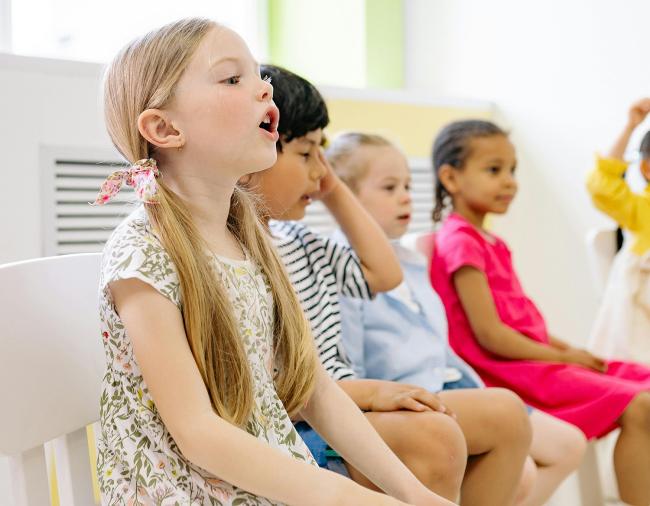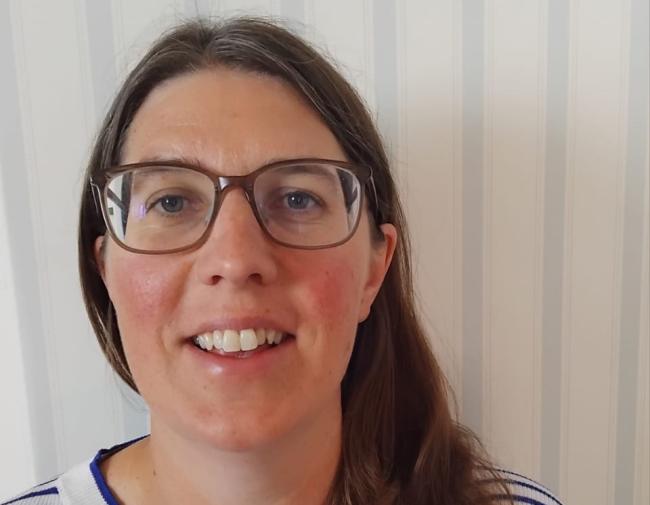
In early summer, the Ingesund School of Music welcomes a new doctoral student in music education. Her name is Stina Wennberg, and she is passionate about music in preschool – an area that will form the basis of her dissertation, with a focus on the musical aspects of singing sessions.
Can you tell us about your background and education?
“I’m from Värmland and grew up on a farm in Väse. My interest in music has always been strong, and after attending a music upper secondary school in Karlstad, I moved to Växjö to study classical piano at a folk high school. When I later applied to a music academy, it was for the Instrumental/Ensemble Teacher program with Eurhythmics pedagogy as my main subject in Malmö. The program no longer exists in the same form, but those of us who completed it are highly sought after when it comes to teaching music to children. Perhaps a new program will emerge eventually—I’m proud to have taken it! After graduating, I stayed in Skåne for many years working as a music teacher in preschools, within El Sistema, at municipal arts schools, and as a eurhythmics educator in the “Rösträtt” concept. I have also continued playing piano and have led choirs in many different settings.”
“For the past eight years, my family and I have returned to Värmland, where I have worked within the Church of Sweden as an educator and choir leader for children and young people. I have also taught music in the preschool teacher education program at Karlstad University. Now, however, I am a full-time doctoral student, and I will also be doing some teaching within the teacher education program at the university.”
You have been very engaged in the Rösträtt – singing in preschool initiative. Can you tell us more about it?
“It was initially a three-year project funded by the Swedish Inheritance Fund from 2011 to 2014. We received substantial funding and had a vision for how we could strengthen music in preschool. In the project, we worked to highlight the importance of music in preschool through collaboration with preschools, arts schools, and other stakeholders. The project resulted in the book “Rösträtt – music on children’s terms”, published in 2014 and still used in teacher education today. The project is part of the “Singing Children” movement but is managed and coordinated by Unga Musik i Syd, the Development Center for YAM Sweden (Regional Music Sweden’s initiative for children and young people). All 21 regions in Sweden participate through their regional music institutions, working together to create a comprehensive effort for singing on young children’s terms. The project is funded for three years by the Swedish Arts Council but has a long-term perspective. Over the past year, I have worked together with Wermland Opera to expand the initiative in Värmland.”
It is said about Rösträtt that the concept is about democracy and children’s participation and influence. Singing together embodies a democratic society where every person has a voice, and every voice matters. In public debate, participation in culture is increasingly seen as a form of preparedness work in an uncertain world. What is your view on that?
“That aspect wasn’t perhaps central at the beginning of Rösträtt. Instead, we based our work on the UN Convention on the Rights of the Child and Roger Hart’s Ladder of Participation from 1991, which is about how adults can find ways to enable children to actively participate in music and culture. But absolutely – singing together creates a sense of community that I believe is an important foundation for understanding that all people have equal value and that everyone has a right to have their voice heard. Together, we become something greater when we sing. It becomes a tool for creating democratic citizens. Someone listens to me, and I listen to others –this is part of the democratic work of preschool.”
What will you research in your new doctoral position at the Ingesund School of Music?
“The foundation is music in preschool. The working title is currently “Expression, development, and participation in preschool singing sessions.” It naturally builds on my previous experience. A few years ago, I wrote a master’s thesis in Malmö about what preschool teachers and educators bring into their work and what singing sessions look like. Singing sessions serve broad purposes – they involve singing, but also community building, language development, and more. I would like to contribute to developing the work with singing sessions and music activities in preschool and provide educators with more tools for working with music.”
What do you think your future doctoral degree will mean for your career?
“I have been part of academia in various roles for many years, not least as a teacher in the preschool teacher education program at Karlstad University. When I haven’t been studying or working, I have also participated in choirs in Malmö and Lund. Music and music education need to be researched – we need to contribute to this so that children can access singing and music in preschool. Research adds further weight to the arguments for this.”
How would you like – or how do you think – your completed dissertation will be used?
“I hope that, in the long term, it will promote music in preschool by strengthening teachers who work with children in this area.”
When Stina is not working, Stina sings in the Karlstad Motet Society. At this time of year, in spring, there is also a lot of gardening, and Stina drives the children to various activities.
“I have a wonderful everyday life!”
Stina Wennberg’s doctoral studies are conducted within the framework of the doctoral school at the Department of Educational Studies at Karlstad University, while her position as a doctoral student is based at the Ingesund School of Music. Guro Gravem Johansen, Professor of Music Education at the Ingesund School of Music, is the principal supervisor, and Kent Fredholm, Senior Lecturer in Education at Karlstad University, is the co-supervisor.