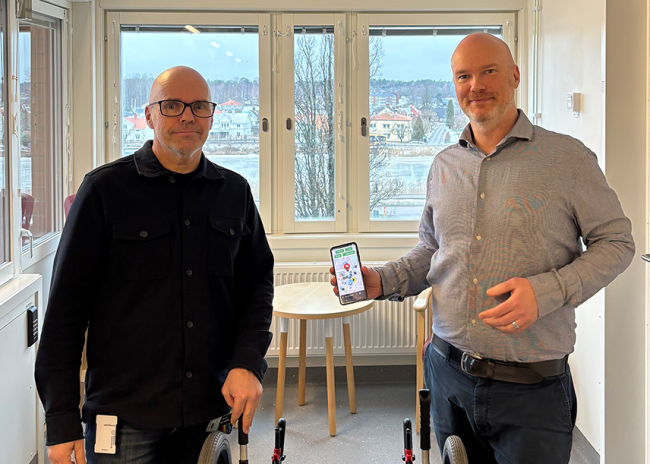
..who helped Central Hospital in Karlstad get its wheelchairs under control. It all started with a newspaper article about the 'wheelchair chaos' at Central Hospital in Karlstad. Missing wheelchairs led to unnecessary searching and added stress in daily operations. At that point, Stefan Alfredsson, a senior lecturer in computer science, contacted the patient transport unit, and together they began exploring whether the problem could be solved.
Today, around 40 wheelchairs at the hospital are equipped with AirTags, allowing staff to track their location in real time using their mobile phones. The solution saves both time and money and recently won Region Värmland’s Innovation Award 2026.
Congratulations on the award! What prompted you to contact the hospital about this particular problem?
“I read a news article in September 2024 about how staff were spending countless hours searching for missing wheelchairs. They had considered implementing a wheelchair-tracking system, but the initiative had been delayed by budget constraints and bureaucracy. I thought there had to be a simpler and more affordable way to solve the problem. It also aligned well with the research we conduct within the Academy for Smart Specialisation and Digital Health Innovation (DHINO/DigitalWell).”
Did you encounter any technical challenges?
“The initial setup consisted of ten tags, but there were technical limitations regarding how many tags a single phone could manage and how many staff members needed access to that phone. Over time, the system was further developed with a web-based digital map that can handle a much larger number of tags, works directly on staff members’ mobile phones without requiring a dedicated app, and collects data for monitoring, evaluation, and operational development.
Another important issue throughout the project was privacy. We had many discussions about how to use the technology responsibly, ensuring that it would not be possible to link a wheelchair to a specific individual and thereby reveal information about that person’s health status. We also had to solve a number of practical challenges, such as protecting the tags when the wheelchairs are cleaned. I designed a custom enclosure for the wheelchair frame, which was then manufactured using a 3D printer in our hackerspace.”
What does it mean to you that the solution not only won an award but also solves a real problem in healthcare?
“It is confirmation that what we have done is meaningful, works in practice, and that we have found an effective model for collaboration between our organizations. Implementing advanced systems often requires a substantial budget, a formal procurement process with requests for proposals, and a lengthy implementation procedure. This affects how quickly a solution can be put into practice. By starting with a simple solution and then developing it iteratively, it can be adapted more effectively to actual needs.
Of course, it is gratifying to receive an award and recognition, but for me the most rewarding aspect is the practical impact. We have found a way to solve an everyday challenge in healthcare that improves the working environment, benefits patients, and enables more efficient use of resources. At the same time, it raises a number of interesting research questions at the intersection of technology and human behavior.”