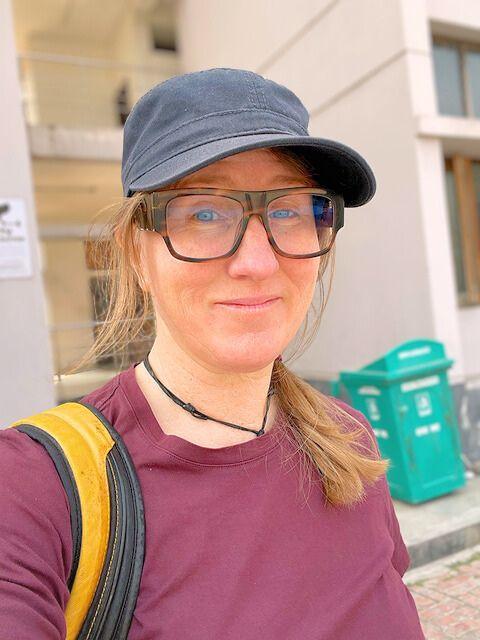
Jennie Segerström is currently pursuing the Master's Programme in Critical Social Analysis in Sociology and works simultaneously as a teaching assistant in Risk and Environmental Studies and at the Centre for Societal Risk Research (CSR). Earlier this year, she was awarded a Minor Field Studies (MFS) scholarship to examine how climate resilience is created in coastal communities in southern Bangladesh. In early February she travelled to Khulna, where she is now conducting fieldwork for her master’s thesis in sociology.
Can you tell us a little about what you are doing?
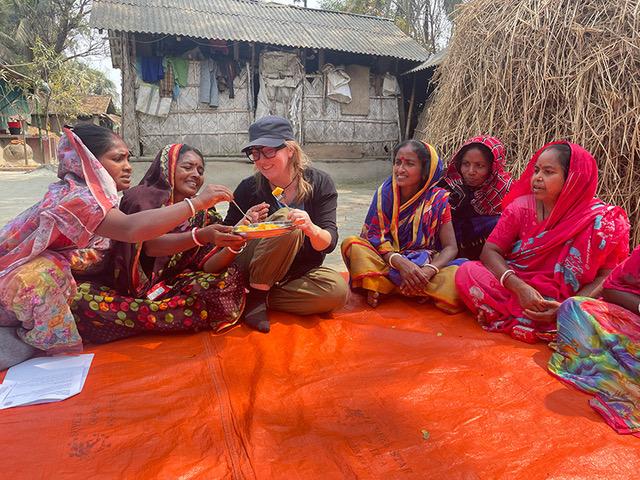
– I am conducting an eight-week field study in Khulna. The study explores how climate resilience is created in practice in coastal delta areas in southern Bangladesh, which are heavily affected by climate change – particularly saltwater intrusion. In this context, resilience is not primarily understood as a technical solution, but rather as something that develops through cooperation, the distribution of responsibilities, and collective organisation. During my fieldwork I conduct small focus group discussions with members of local community organisations in order to examine how they collaborate on issues related to water management, livelihoods, and adaptation to a changing climate.
What made you interested in studying this topic?
– I have a background in leadership and organisational work, where cooperation, structure, and the distribution of responsibilities have been central questions. For me, sociology has become a way of deepening the understanding of how groups and organisations function in practice – particularly in situations where societies face change and uncertainty. My study therefore operates in the intersection between sociology and risk and environmental studies. In addition, much of the existing research on this topic focuses either on the individual level or on national systems, whereas I am more interested in what happens in between these levels.
Why did you choose to focus your research on Bangladesh?
– Bangladesh is one of the countries that has lived with the tangible consequences of climate change in everyday life for a long time. Adaptation here is therefore not a future issue but something that is already taking place, which makes the location particularly interesting. The country holds experiences that many other societies have not yet needed to articulate fully. CSR also has an international collaboration with several leading Bangladeshi universities through the BASCHER network. It therefore made sense to carry out my fieldwork here.
What are the goals of your field studies?
– By examining how people organise themselves, share experiences, and make collective decisions, I hope to gain a deeper understanding of how adaptation actually becomes possible in everyday life. It is also interesting to explore how sociological field-based research can function as a bridge in international collaboration, through the partnership between Karlstad University and Khulna University. This applies not only through research results, but also through relationships and shared knowledge development.
How did you prepare for the trip?
– I familiarised myself with the region and previous research conducted there, and maintained close dialogue with researchers and colleagues within the network. I also made sure to get the necessary vaccinations, acquire proper mosquito protection and nets – and of course to pack a bag of Swedish salted liquorice from home. I also brought a few photographs of my family, both to hang on the wall for my own sake and to show if curious people ask. Fieldwork is not only about collecting data. Much of it involves building trust and sharing everyday life, which makes practical preparation just as important as analytical preparation.
Can you reveal anything so far?
– It is still early in the process, but I am already observing how the composition of groups and the sense of security within them influence what becomes possible to say. In one focus group, clear generational differences emerged in how experience and legitimacy shape the conversation – who speaks about the past, and who speaks about the present and the future? In another group, unity and cooperation were emphasised as crucial resources in dealing with saltwater intrusion and changing living conditions. The differences between the groups are interesting in themselves, as they can illustrate how organisation and trust influence adaptive capacity. A local expression shared during one conversation has stayed with me: “Feeling unwell is difficult – but having your home damaged is even worse.” It says something about what is at stake and why cooperation becomes more than an ideal – it becomes a necessity. Meeting the people here reminds me that adaptation is not only about technology and infrastructure. It is about solidarity, everyday forms of organisation, and the ability to stay together when conditions change. I am often struck by how the warmth here does not only come from the climate, but also from the encounters with people. In that sense, the word resilience almost takes on a double meaning.
What would you say to someone considering applying for an MFS scholarship?
– Fieldwork requires careful listening, slow thinking, and a willingness to reconsider one’s own assumptions. Plan early what your thesis will focus on so that you have time to apply for the scholarship for the coming semester. MFS offers an incredible opportunity to test one’s analytical abilities in a new context. It requires planning and humility, but it provides perspectives that are difficult to gain at home.
------------------------------
Good to know:
MFS
Minor Field Studies is a Sida-funded scholarship programme that all programme students at Karlstad University can apply for, regardless of academic discipline. The scholarship allows students to conduct a field study or collect data for a thesis over a minimum period of eight weeks. The field study is carried out in a country where the Swedish government has active development cooperation strategies and must be connected both to current research and to international collaboration at the student’s faculty or department. You can read more about the MFS programme here:
The BASCHER-network
The BASCHER network (Bangladesh-Sweden Climate Change and Health Research Network) is a collaboration between the Centre for Societal Risk Research and researchers at the Bangladeshi universities Khulna University, Bangabandhu Sheikh Mujib Medical University, and North South University, with active participation from the Centre for Injury Prevention and Research Bangladesh. The aim of this interdisciplinary research collaboration is to contribute to increased knowledge about the urgent need to address climate change and its health effects – politically, practically, and through greater public awareness. The collaboration focuses in particular on the mental health of vulnerable groups living in coastal areas of Bangladesh. More information about the network can be found here: