Pursuing doctoral studies is often described as climbing Mount Parnassus, the divine mountain where the well‑educated were allowed to gather according to Greek mythology. Earning a doctorate is hard work and at times quite a solitary existence, often an uphill climb that stretches over several years. But what is it like to pursue a doctorate in music? Two teachers at Ingesund School of Music are doctoral candidates at the School of Music in Piteå, which belongs to Luleå University of Technology, and they have now reached the halfway point in their studies.
What made you decide to begin doctoral studies?
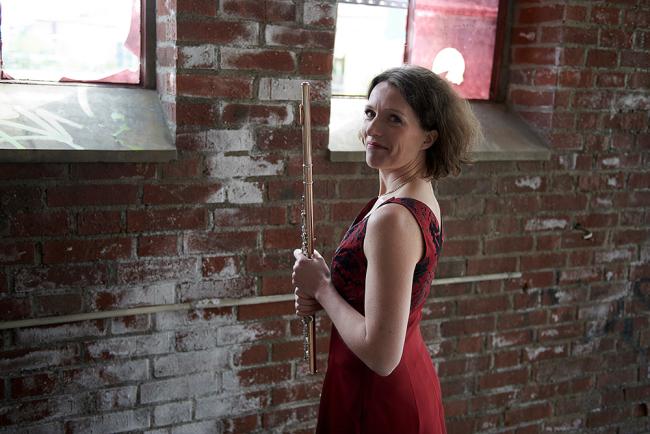
“Much of it was due to the pandemic,” says Ann Elkjär, flute teacher. “Before that, I had taught half‑time for many years at Ingesund and freelanced as a musician the rest of the time. During the pandemic, all concerts were cancelled, but then the opportunity arose to pursue a PhD half‑time at the School of Music in Piteå at Luleå University of Technology. Also, there aren’t that many teachers with a PhD at Ingesund, and that competence is needed for teaching in our music programmes.”
“For me, the research question grew out of my own practice,” says Georg Gulyas, guitar teacher. “It really began with a desire to break free from the strong Werktreue tradition that I grew up in — the idea that interpretation is primarily about being ‘true to the work’. I noticed that this tradition both shaped and limited how I played, taught, and thought about music. So the research interest I have today emerged from wanting to understand those boundaries, become more aware of them, and then dare to challenge them. It was less about finding a topic and more about following an irritation, a curiosity, and a sense of discovering a new process for interpreting instrumental music.”
What are you studying?
“Oral storytelling in dialect — something I’ve been curious about my whole life,” says Ann Elkjär. I grew up with the Fryksdalen dialect, which is the traditional dialect spoken in Fryksdalen in Värmland, Sweden, the area surrounding the Fryken lakes (Upper, Middle, and Lower Fryken) in the municipalities of Sunne, Torsby, and parts of Kil. I have always felt it is so similar to music and always wanted to take a closer look at it. For instance, I’ve listened to material at the Institute for Language and Folklore; they have a huge archive of recordings from the 1930s, 40s, and 50s. At that time, people believed dialects were disappearing, so they travelled around Sweden recording them. I have listened especially to Wilhelm Larsson, a primary school teacher and cultural figure in Fryksdalen, and I’ve written down how he speaks in musical notation in order to interpret it.”
“My topic is artistic interpretation,” says Georg Gulyas. “Specifically, I investigate how literary text — and now dramatic text — can expand the interpretive frameworks of notated Western classical guitar music and raise awareness of the interpretive process in higher music education.”
Pursuing a PhD in music requires four years of full‑time study (240 ECTS credits) leading to a doctoral degree — or eight years if done half‑time, as is the case for both of them. What happens when you reach the halfway point?
“I had my halfway seminar in autumn 2025,” says Ann Elkjär. “I presented four different projects I’ve been working on. An opponent participated and gave me feedback. It was like an inspection of the entire doctoral project, and the opponent’s comments were extremely valuable to me.”
“After my halfway seminar in November 2025, the project changed quite noticeably,” says Georg Gulyas. “The focus has shifted from a more pedagogical perspective to a scenic and dramaturgical one. I now work more physically, performatively, and intermedially, often in collaboration with theatre director Jörgen Dahlqvist in Malmö. It is in these practical, stage‑based laboratories that I test my interpretations and theories.”
And what does the next phase look like?
“Now I need to bring the four projects I’ve nearly completed to shore,” says Ann Elkjär. “This spring I will begin a collaboration with David Engström, also a teacher at Ingesund and a doctoral candidate at the School of Music in Piteå, where we will set Fryksdalen dialect texts to music.”
“The next phase is mainly about completing my work on Royal Winter Music,” says Georg Gulyas. It is a two‑part guitar work by Hans Werner Henze, one of the most significant post‑war composers, where each movement portrays a Shakespeare character — but without words, solely through the rhetoric of the music. That makes the work perfect for research in musical interpretation. Shakespeare is often described as someone who truly understands human nature, and some say that all art is ultimately about making human behaviour visible. When his characters meet Henze’s music, a wealth of interpretive possibilities arises that can be explored both musically and scenically. So the next step in the project is twofold: continuing the practical work on the remaining movements — studying, interpreting, and recording them — and delving deeper into theoretical literature about the relationship between music and drama. Much of the dissertation will be based on exactly this: how instrumental music can ‘speak’ in dialogue with drama and textual worlds. Working with Henze’s music is, of course, very inspiring since he is one of the foremost composers of the post‑war era. And Shakespeare? Well, he’s a pretty decent playwright too.”
When do you think you’ll be finished?
“My goal is to finish on October 6, 2028,” says Ann Elkjär. “My colleague Georg has his birthday on October 5 and plans to defend then, and my birthday is on the 6th, so that’s when I plan to defend.”
“My plan is to finish in October 2028,” says Georg Gulyas.
What new opportunities open up in your career once you have a doctorate?
“Then my ‘driver’s licence for research’ will be in hand, and I can apply for funding to conduct further research on the job,” says Ann Elkjär. “It’s a privilege to be able to dive deeply into things I’m interested in and also collaborate with others — why not linguists, for example?”
“As I am already employed as a professor of guitar on an artistic basis at Ingesund School of Music, Karlstad University, I feel that I have already been invited to more collaborations,” says Georg Gulyas. “For instance, last year I lectured at the University of Adelaide in Australia. However, a doctoral degree opens the door to even more research projects and international collaborations.”
Read more about Ann Elkjär
Read more about Georg Gulyas
Description of what it is like to pursue a PhD in music according to AI:
Pursuing a PhD in music involves four years of full‑time study (240 ECTS credits) leading to a doctoral degree, often with a focus on artistic research, music education, or musicology. It requires an advanced-level degree (master's) and can lead to research positions, artistic work, teaching, or leadership roles within the cultural sector.