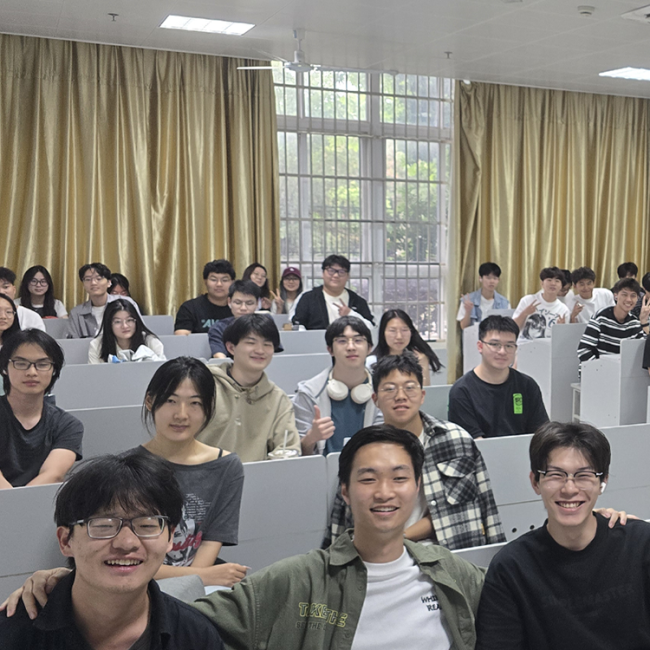
How does theory become real competence? During a teaching assignment in China, the classroom was transformed into an engaging and participatory learning environment. Through prototyping and active collaboration, students developed both knowledge and confidence.
– At Karlstad Business School we put the same approach at the centre of learning. As a student, you actively shape your own learning process, says John Sören Pettersson, professor in information systems.
During a teaching period in China, the connection between theory and practice became particularly clear in web development courses. By using prototypes and a participant-centered approach, the classroom became an active learning environment.
– Jiangxi University of Finance and Economics (JUFE) and Dalarna University have maintained an exchange partnership for many years. A number of teachers from Dalarna teach second-year students, and in the fourth year around twenty students travel to Dalarna, explains John Sören Pettersson.
This year, however, it was Kevin Berling, a master's student in information systems, who taught introductory-level students in China. He had recently completed a course in co-design and user-centered systems development.
– Instead of simply presenting finished solutions, I used small code examples, live demonstrations, and step-by-step exercises as prototypes, says Kevin Berling. This made abstract concepts more tangible. Students could immediately see how changes in the code affected the outcome, which contributed to a deeper understanding.
Learning as an Iterative Process
Teaching became a process in which both teacher and students contributed actively. The teacher's role was not merely to lecture, but also to create situations where students could explore and learn for themselves.
– The teaching process became iterative: I introduced a concept, the students tested it, challenges became visible, and I adapted my explanations accordingly, says Kevin Berling.
Students worked hands-on by modifying code, comparing results, and asking questions. In this way, mistakes and misunderstandings became a natural part of the learning process rather than something to be avoided.
Prototypes as a Pedagogical Tool
Prototypes played a central role in the teaching approach. Even simple exercises functioned as early versions of a solution.
– A prototype does not have to be a finished product. Even a simple HTML/CSS exercise can serve as a way to explore design decisions, says Kevin Berling.
By working with these early versions, students were able to experiment with structure, visual hierarchy, and responsiveness before arriving at a final web design.
The Classroom as a Collaborative Environment
The teaching experience can also be understood as an example of participatory design. Students actively influenced how the course developed.
– The students' reactions showed which parts were clear and which needed to be explained differently, says Kevin Berling.
This turned the classroom into a shared design process in which both content and teaching methods were shaped through dialogue between teacher and students.
A More Dynamic Learning Process
The experience demonstrates how prototyping and participatory design can work in practice, not only as theoretical concepts. The result was a learning environment that was more flexible, responsive, and adapted to students' needs.
– The learning process became more iterative, practical, and attentive to the students' actual needs, says Kevin Berling.
By combining small prototypes with active student participation, the teaching approach created a learning environment where learning became something students do, rather than something they simply receive.
Being a Teacher as a Student
Kevin also reflects on how educational structures can differ between countries. At JUFE, there was considerably more flexibility in scheduling classes than at the School of Business.
There were two classes with around fifty students each, but since every student had made individual course selections, some lectures were scheduled after 5 p.m. to avoid clashes with parallel courses.
– It was fun spending time with the students, says Kevin Berling. I often had lunch and dinner with them on campus or at restaurants just outside the university gates.
Kevin also notes that there were some language-related challenges. On the very first day, students asked him to speak much more slowly. The students also helped one another formulate questions in English.
– But it works very well as long as you take the time, he says. After lectures, I would usually ask the students what they found difficult and what they thought I should cover next.