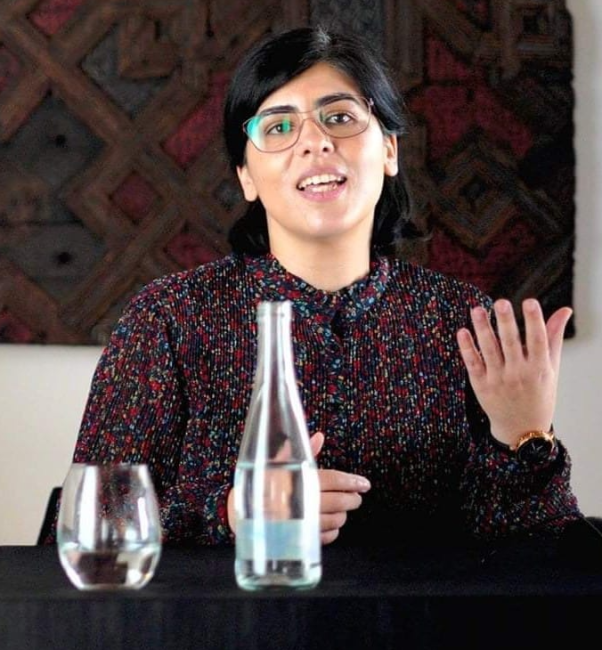
Ana, what is the reason for your visit to Karlstad University and Geomedia?
– When FCT, the Portuguese research agency, presented an exceptional scheme with funds EC’s Recovery and Resilience Plan for mobility abroad, I immediately thought of Geomedia to finish working on the project’s book, and find a stimulating intellectual environment to develop my research further. I had worked with André Jansson in 2023-24, who worked as an external advisor to our funded project On&Off, and I was looking for further dialogue with Karin Fast and Mats Nilsson.
How would you describe the research field of Geomedia?
– Geomedia looks at the intersection between Media and Communications, on the one hand, and Geography, on the other. It is an inspiring research field priming aspects related to space and materiality in analysing media and communications.
And what will you be doing at Karlstad University during your visit?
– During this one-month visit, I will be focusing on writing an article on representations of pilgrimage to Santiago de Compostela on Instagram, together with Mats Nilsson.
Tell us about your upcoming book Atmospheres and Digital Media: Connection and Disconnection Across Everyday Life
– It explores how encounters with digital and social media can change and drift in response to particular affective atmospheres, which are both individually and collectively embodied, and affected by spatial, material, and cultural circumstances. I’ve co-edited this book with Sofia Caldeira, and it reports on extensive qualitative research conducted under the project On&Off: atmospheres of dis/connection, which ran between 2022 and 2024 in Portugal.
– The book chapters prime different dimensions of atmospheres in the analysis of four different micro-environments across everyday social situations, specifically: the affective relationships of parents and children with and around digital media; the interplay between affective states and social media ambiences among activists; the affective temporalities in pilgrimage as they are constructed by communities as well as the platforms; and the intensities at play in using, not using, or modulating digital media during grief processes.
Can you give some examples of the feelings that emerge between people, platforms and places?
– Our study on pilgrimages to Santiago de Compostela, Fátima, and the 2023 World Youth Day in Lisbon explores how people’s use of digital media evokes, builds, and augments collective feelings of anticipation, presence and longing for the experience of pilgrimage. Through ethnographic work, we could see, for instance, how people both plan and sometimes dread the pilgrimage, and how they feel impelled to be present and focused on the pilgrimage, but also share on social media about this emotionally intense experience.
Do you have any guidelines for how we as humans should relate to digital media in 2026?
– I often get asked variations of this question, but I don’t! Firstly, because I try to resist a normative position and am interested in understanding people’s relationship with digital media. Secondly, you could argue that it is increasingly difficult to separate what is human from what is digital media. Still, I would say to refuse a view of digital media as mere tools, or that we as people are mere tools (or fools?) of technology. We can critique and question more the normalization we might make of the role that digital technologies play in our lives, discuss norms, find new agreements as families, communities, societies.
Please tell us briefly about your current research and why you chose this topic
– Currently, I am starting new research about discourses and practices around money and finances. I chose this as I started to see this type of content on social media, e.g. crypto-currencies and sponsorships from new financial apps for concerts; but also, from my experiences when travelling abroad and seeing different architectures for how money is exchanged and how much this is entangled with apps.