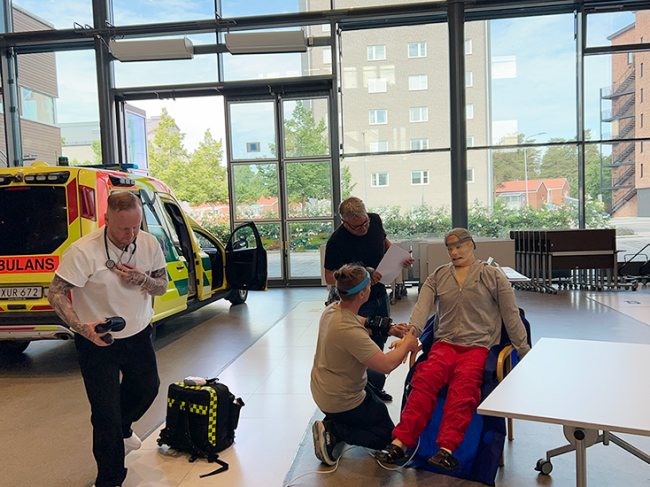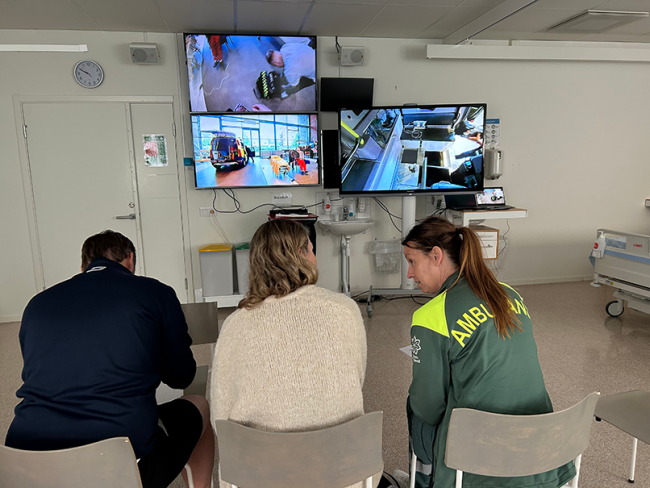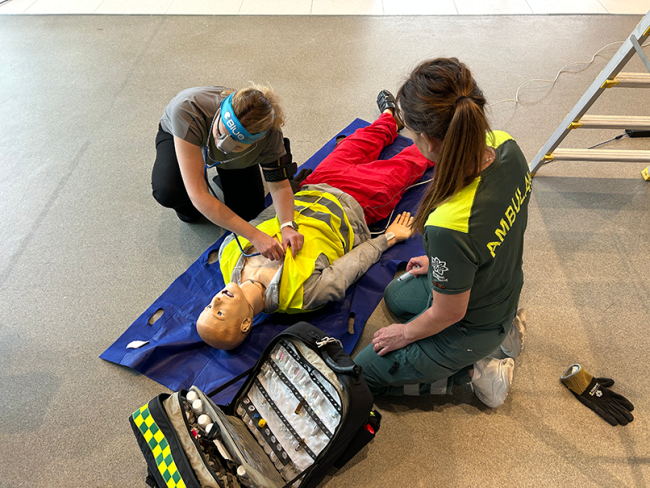
Recently, two successful trials were conducted within the 6G-PATH research project, where nursing students and ambulance personnel tested a new form of remote healthcare education.
The aim was to investigate how next-generation communication technologies such as 5G, future 6G networks, edge computing, and cloud services can be used to create realistic and accessible learning environments for healthcare professionals.
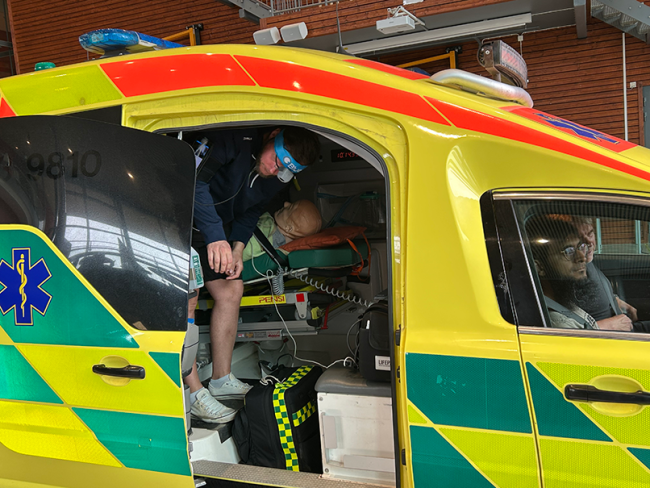
During the trials, students participated in simulated emergency situations where they practiced assessing and treating patients in need of immediate care. One of the scenarios took place in a moving ambulance to replicate real-world conditions in prehospital care. Using a mobile network connection, an advanced patient simulator could be controlled remotely, creating an authentic and flexible learning environment.
Practical exercises are a fundamental part of nursing education, and the results show that the technology can help create more realistic training scenarios beyond the traditional classroom setting. After the exercises, students evaluated their experiences through questionnaires, and the feedback was overwhelmingly positive.
The project included two demonstration sessions focused on exploring how the technology can enhance healthcare education.
“One important conclusion is that the ability to create authentic learning environments outside the campus setting opens up new opportunities for the future of education. By combining mobile communication technologies with advanced simulations, training can become both more flexible and more true to life,” says Anna Nordin, Associate Professor of Nursing.
“We see great potential in using this technology to make advanced healthcare education accessible to more students, regardless of their geographical location. At the same time, healthcare professionals can gain better opportunities to practice managing complex situations in environments that closely resemble real-life conditions,” says Anna Brunström, Professor of Computer Science and project leader of DRIVE.