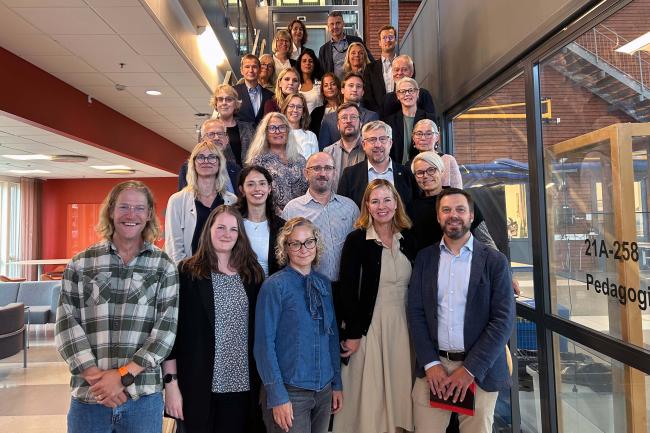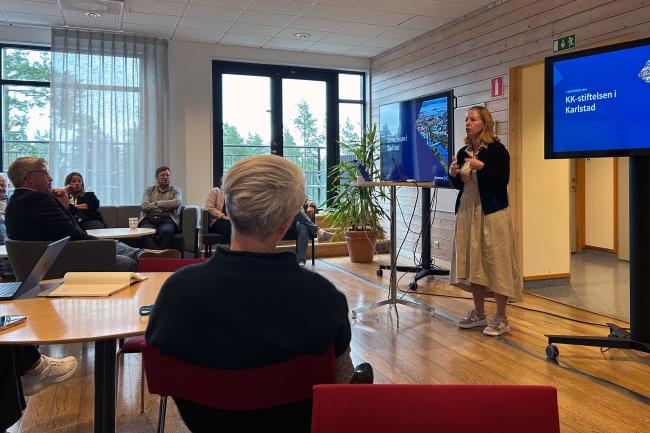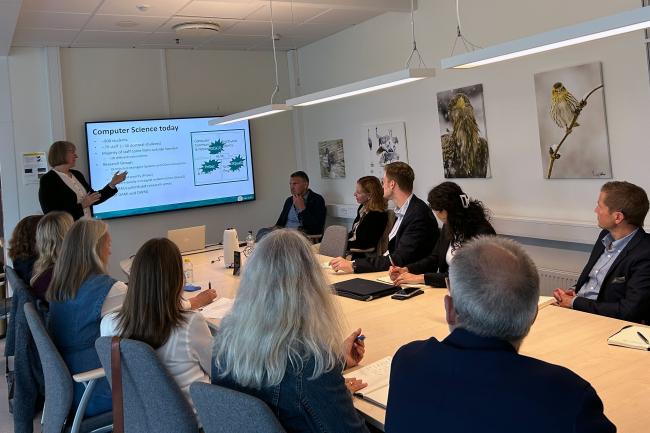
On 7 September, representatives from the Knowledge Foundation (KK-stiftelsen) visited Karlstad University to gain deeper insight into how the university collaborates with industry in research and education. During the visit, several projects were presented in which the university and companies work together to develop new knowledge and strengthen Sweden’s competitiveness.
Throughout the day, the representatives from the Knowledge Foundation met researchers and academic staff from the Pro2Be research environment and the Department of Computer Science. The aim was to gain a better understanding of how the university works with research, education and skills development in partnership with companies and organisations.
“I think it has been a very interesting visit. We have been given concise yet highly informative presentations of various projects that we help fund. We have also had the opportunity to look at them from different perspectives, which has provided an excellent picture of the activities and their outcomes,” says Eva Schelin, Chief Executive Officer of the Knowledge Foundation.
Since its establishment in 1994, the Knowledge Foundation has funded more than 3,600 projects at Swedish university colleges and newer universities. Its mission is to strengthen Sweden’s competitiveness by supporting research and education in close collaboration with industry. In 2025, the foundation funded around 60 new projects.
Collaboration as the Foundation of Research and Education
At Karlstad University, the visitors were introduced to several examples of how collaboration permeates both education and research. Stefan Frodeson, Head of the Department of Engineering and Chemical Sciences, together with colleagues, presented the Pro2Be research environment, Processes and Products for a Sustainable Bioeconomy. The visitors learned about collaborative initiatives in the bioeconomy sector, the EXACT industrial graduate school, and Mission 0 House, where academia and industry work together to eliminate greenhouse gas emissions.
For students, the connection to industry is particularly evident. Across several engineering programmes, a large proportion of degree projects are carried out in collaboration with companies, contributing to strong employability and successful entry into the labour market after graduation.
From Research to Industrial Application
The day also highlighted several research projects developed in partnership with industry. Within Infinity Fiber, an initiative building on the established Pro2Be research environment, 14 industrial partners collaborate with researchers to develop the fibre-based materials and products of the future. The project builds on existing research and infrastructure and focuses on scaling solutions from laboratory settings to pilot and industrial scale.
The researchers emphasised that collaboration not only helps ensure that research results benefit society, but also contributes to the formulation of new research questions.
“Collaboration is essential if we are to achieve what we want to accomplish through our research. It is not a matter of choosing between basic research and applied research, but of allowing curiosity and societal needs to meet,” says Björn Sjöstrand, Associate Professor of Chemical Engineering at Karlstad University.
Computer Science with Strong Industry Links
The Knowledge Foundation’s visit continued at the Department of Computer Science, where Professors Anna Brunström, Simone Fischer-Hübner and Stefan Lindskog presented how the research environment has evolved since the late 1990s.
Computer Science at Karlstad University has been built over many years through close collaboration with industry and public-sector organisations. From the first industry-funded projects to today’s extensive project portfolio, collaboration has been a central part of its development.
The visitors were introduced to the work of research groups such as DISCO, PriSec and SQuaD, as well as the Knowledge Foundation-funded profiles DRIVE and SIGS-CyberSec, which bring together researchers and companies to address the digitalisation, cyber security and data-driven innovation challenges of the future.
Important for Future Competitiveness
For the Knowledge Foundation, visits of this kind are an important way of understanding the conditions required for successful collaboration between academia and industry.
“We want to understand how research, education and collaboration work together in practice. What do universities, students and researchers need in order to succeed? And what does industry need to build long-term competitiveness? Visits like this provide valuable insights into how collaboration functions in practice and the difference it makes,” says Eva Schelin, Chief Executive Officer of the Knowledge Foundation.