Teaching
Stefanos Georganos teaches within the Geomatics programmes at Karlstad University, with a focus on programming and quantitative spatial analysis. He developed and is responsible for Introduction to Python for Geomatics and Geospatial Python, two courses that introduce students to open-source, reproducible geospatial workflows, from basic programming concepts through to automating GIS processing, working with spatial libraries and APIs, and producing publication-quality visualisations in Jupyter notebooks. Both courses are project-based: students build a complete, documented and replicable analysis workflow. He also teaches advanced spatial statistics, including spatial autocorrelation and geographically weighted regression, remote sensing and contributes to courses on scientific method and thesis writing. He has supervised bachelor's, master's and doctoral students working on remote sensing, machine learning and spatial data science topics.
Collaboration
Stefanos Georganos's research is built on long-running international collaboration. He is Principal Investigator of DEPRIMAP (Unravelling the dynamics of deprived urban areas in the Majority World using AI and Earth Observation to foster evidence-based sustainable planning), funded by a FORMAS early-career grant (2023-01210), which maps and models deprived urban areas across the Global South. He is also Co-Principal Investigator of DYNEO, a joint project with Belgian partners. These build on his earlier work in the Belgian Science Policy Office (BELSPO) STEREO-III projects SLUMAP (Remote Sensing for Slum Mapping and Characterisation in sub-Saharan African Cities, SR/11/380) and ONEKANA (SR/11/405), which developed open-source, low-cost frameworks for mapping urban deprivation and population using Sentinel-1/2 and very-high-resolution imagery. His collaborative network spans Université libre de Bruxelles, the University of Twente (ITC), the University of Würzburg, KTH, the University of Navarra, and extends through the IDEAMAPS Network and the Swedish national competence centre SESAC.
Selected Projects
SESAC— Swedish Competence Centre for Satellite-Enabled Social Science Analytics. Karlstad University partner. Swedish National Space Agency (Rymdstyrelsen), 2025–2027, hosted by Lund University with Chalmers, Linköping University and Karlstad University. https://sesac.se/
DEPRIMAP — Unravelling the dynamics of deprived urban areas in the Majority World using AI and Earth Observation to foster evidence-based sustainable planning. Principal Investigator. FORMAS (Swedish Research Council for Sustainable Development), application 2023-01210. https://sola.kau.se/deprimap/
DynEO4SLUMS — Space-Time Dynamics of Slums and Vulnerable Communities Exposed to Multiple Hazards. Co-Principal Investigator. https://dyneo4slums.ulb.be/ Belgian Science Policy Office (BELSPO)
ONEKANA — Citizen science and Earth Observation for population estimation in deprived urban areas of Nairobi. Belgian Science Policy Office (BELSPO). https://onekana.ulb.be/
SLUMAP — Remote Sensing for Slum Mapping and Characterisation in sub-Saharan African Cities. Belgian Science Policy Office (BELSPO),. https://slumap.ulb.be/
Bio
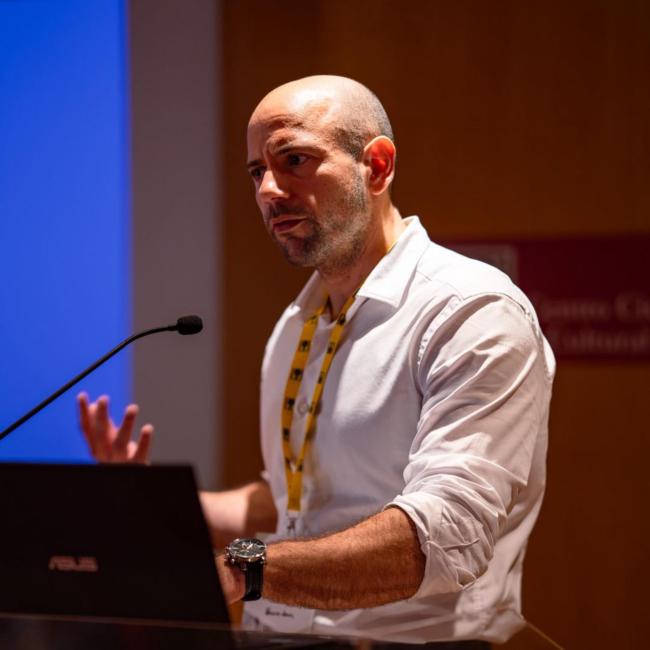
Stefanos Georganos is Associate Professor (Docent) in Geomatics at Karlstad University, working at the intersection of remote sensing, machine learning and urban geography. His research develops Earth Observation methods for mapping populations, settlement patterns and urban deprivation, with a particular focus on rapidly growing cities in sub-Saharan Africa. A recurring theme in his work is how satellite imagery can be combined with spatially explicit statistical and deep learning models to produce reliable information in contexts where conventional census and survey data are sparse or outdated and how the uncertainties in such estimates should be handled and communicated. He is affiliated with Université Libre de Bruxelles, and serves as the current President of EARSeL (European Association of Remote Sensing Laboratories), a pan-European network of hundreds of laboratories.
Selected publications
· Georganos, S., Grippa, T., Niang Gadiaga, A., Linard, C., Lennert, M., Vanhuysse, S., Mboga, N., Wolff, E., & Kalogirou, S. (2021). Geographical random forests: a spatial extension of the random forest algorithm to address spatial heterogeneity in remote sensing and population modelling. Geocarto International, 36(2), 121–136. https://doi.org/10.1080/10106049.2019.1595177
· Georganos, S., & Kalogirou, S. (2022). A forest of forests: a spatially weighted and computationally efficient formulation of geographical random forests. ISPRS International Journal of Geo-Information, 11(9), 471. https://doi.org/10.3390/ijgi11090471
· Kuffer, M., & Georganos, S. (Eds.) (2024). Urban Inequalities from Space: Earth Observation Applications in the Majority World. Remote Sensing and Digital Image Processing, vol. 26. Springer, Cham. https://doi.org/10.1007/978-3-031-49183-2
· Friesen, J., Georganos, S., & Haas, J. (2025). Differences in walking access to healthcare facilities between formal and informal areas in 19 sub-Saharan African cities. Communications Medicine, 5, 41. https://doi.org/10.1038/s43856-025-00746-5
· Karagiorgos, K., Georganos, S., Fuchs, S., Nika, G., Kavallaris, N., Grahn, T., Haas, J., & Nyberg, L. (2024). Global population datasets overestimate flood exposure in Sweden. Scientific Reports, 14, 20410. https://doi.org/10.1038/s41598-024-71330-5
· Georganos, S., Abascal, A., Kuffer, M., et al. (2021). Is it all the same? Mapping and characterizing deprived urban areas using WorldView-3 superspectral imagery. A case study in Nairobi, Kenya. Remote Sensing, 13(24), 4986. https://doi.org/10.3390/rs13244986