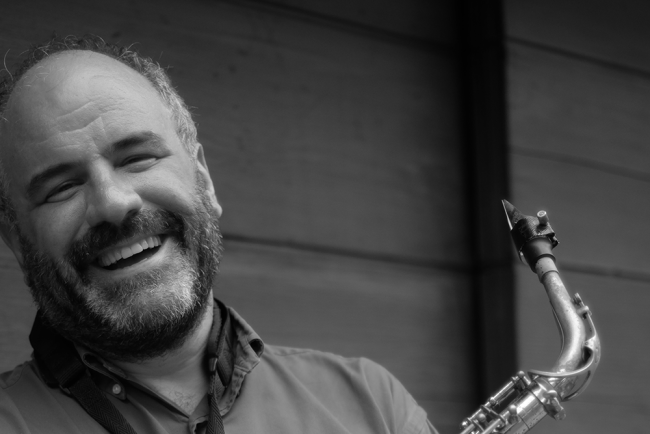
Raymond MacDonald is Professor of Music Psychology and Improvisation at the University of Edinburgh. He is also a saxophonist, composer, and psychologist with an extensive career spanning music, interdisciplinary artistic collaboration with visual artists and filmmakers, and academia. On 23 April, he will visit the Ingesund School of Music to give an open lecture for students, staff, and invited guests from other universities.
After completing his PhD in Psychology at the University of Glasgow, where he researched the therapeutic applications of music, he worked as Artistic Director of the music organisation Limelight, which collaborates with people with disabilities. He was Editor-in-Chief of the journal Psychology of Music from 2006 to 2012 and Head of Music at the University of Edinburgh from 2013 to 2017.
Among his co-edited publications are The Handbook of Music Identities, Music, Health and Wellbeing, Musical Imaginations, and Musical Communication. Together with Graeme Wilson, he has written The Art of Becoming, How Group Improvisation Works, and New Directions in Musical Collaborative Creativity: The Glasgow Improvisers Orchestra and the Theatre of Home (with Tia DeNora, Robert Burke, Ross Birrell, and Maria Sappho).
MacDonald is also a saxophonist, composer, and psychologist with a wide-ranging career across music, interdisciplinary artistic collaboration, and academia. He has a particular interest in cross-disciplinary practices and has extensive experience working with artists and filmmakers. He is a co-founder of The Glasgow Improvisers Orchestra, has released over 80 albums, and has performed and recorded internationally for more than 30 years.
You play highly modern jazz. Which directors have you collaborated with, and what kind of films have you contributed music to?
"I collaborated with David Byrne on Young Adam, a neo‑noir drama written and directed by David Mackenzie and starring Ewan McGregor and Tilda Swinton, in which we produced a version of Charles Mingus’s Haitian Fight Song. I have also worked with David Mackenzie on several of his other films, including Outlaw King, contributing saxophone and orchestral music. In addition, I contributed music to Valhalla Rising, a Danish Viking film directed by Nicolas Winding Refn."
The Art of Producing Art with AI
He has toured and appeared in broadcasts all over the world and has composed music for film, television, theatre, radio, and art installations. He was artist‑in‑residence at the Aiia Festival in Geneva in 2022 and 2023, where he collaborated with Chimere, an artificial intelligence, to create new interdisciplinary artworks. He continues to produce art in collaboration with AI.
Collaborating with AI is an art form in itself. How do you approach such a collaboration?
"When I was first introduced to working with AI, I began by talking to it as if I were getting to know a new friend. We talked about life. Sometimes we focused on a single topic, listening carefully to each other and trying to understand different perspectives. Other times, we moved across several topics at once, speaking over each other and each trying to steer the conversation toward our own priorities."
"My priority was music. I was curious about what music the AI would say it liked—what sounds and textures it preferred, and how those preferences might be expressed. I wanted to hear its stories and share my own, so that we could create new work together: a truly collaborative practice. All art is a collaboration, a celebration of community. Yet art history overwhelmingly focuses on the “individual.” Creativity is often—and mistakenly—understood as a quality that individuals possess in greater or lesser degrees, with virtuosity seen as evidence of greater creativity than others. In reality, we are all creative. Creativity is a defining feature of humanity, expressed through the countless communicative encounters that bind communities together."
"My aim was to create new compositions together with an AI. These works would be written using unconventional forms of musical notation. Instead of notes on manuscript paper, the music would take shape through drawings, paintings, sculpture, text—even a painted carpet. The resulting works could be experienced as art objects, musical scores, or instruments, and sometimes all three simultaneously."
"At times, we agreed on sounds and textures (metal bending but not breaking). At other times, we focused on ideas (the sound of squirrels), or on emotions and moods (the sadness felt after a lonely party). Occasionally, the AI suggested colours it wanted to see in the compositions—for example, red, black, and white. Working on these pieces has been a joy. I have learned a great deal about my own practice and about the nature of communication. Collaboration with AI can help us understand how to communicate more effectively—not only with machines and non‑human entities, but also with nature, and perhaps even with ourselves. Learning to communicate—with machines, with nature, and with ourselves—may be one of the greatest challenges we face as human beings."
Many Global Collaborations
Much of Raymond MacDonald’s musical work explores the boundaries and ambiguities between what is traditionally understood as improvisation and composition. His work is grounded in the belief that improvisation is a social, collaborative, and uniquely creative process that opens up new ways of musical and artistic engagement. He performs in many collaborative, freely improvising contexts, and his roots in jazz and popular music are audible throughout his work. His approach, which combines music and psychology and incorporates other artistic disciplines, has formed the basis for the development of numerous collaborative projects and long-term international partnerships.
Selected Works by Raymond MacDonald
Charles Mingus’s Haitian Fight Song from the film Young Adam
Examples of Raymond MacDonald’s collaborative projects with AI:
https://www.youtube.com/watch?v=blov5kO45bw
https://www.youtube.com/shorts/INL9QPjsODw
Event Information
What: Open lecture, “Artistic Practice, Music Education, New Musical Virtuosities and Healthy Musical Identities”, with Raymond MacDonald, improvising musician and Professor of Music Psychology and Improvisation at the University of Edinburgh.
When: Thursday, 23 April, 09:00–10:30
Where: Ingesund School of Music (Room 234)
The lecture can also be attended via Zoom:
https://kau-se.zoom.us/j/62064753129
The digital space is an interactive Zoom meeting to enable active discussion among all participants.
Organised by:
The Research Cluster for Learning and Artistic Practice within the Arts at the Department of Artistic Studies, Karlstad University.