Students at Karlstad University have developed a method that enables more realistic simulations of how future 6G networks could be used for both communications and positioning. The study focuses on Integrated Sensing and Communication (ISAC), a technology that allows mobile networks to simultaneously transmit data and detect objects in their surroundings.
As part of the research project, students Ronahi Ali, Eric Lövås and Hampus Werner, in collaboration with Tieto Sweden AB, further developed the simulation tool NVIDIA Sionna RT to enable radio signals to be directed towards specific areas, much like in real-world antenna systems. This makes it possible to analyse how signals are reflected by different objects and, in turn, estimate their position and size.
“I think we were very successful because we had excellent teamwork and strong communication between Eric, Hampus and myself. We also received a great deal of support from our supervisor, Bengt Hallinger at Tieto. In addition, I personally gained a great deal of knowledge and valuable guidance from my supervisor, Giuseppe Caso at Karlstad University,” says Ronahi Ali, a student on the Master of Science in Engineering programme in Computer Engineering and one of the authors of the paper Leveraging Sionna RT for ISAC and Positioning: Extending Ray Tracing with Directional Beam-Constrained Propagation.
“We also had access to all the materials and resources we needed from Tieto. The topic itself was something I was personally interested in, which made the work both more enjoyable and more motivating.”
The method was tested in virtual environments, both indoors and outdoors. The results showed that the system was able to successfully identify and locate objects with a high degree of accuracy.
The new solution could become an important tool in the development of future 6G technologies. By enabling more realistic simulations, it may help accelerate the development of new solutions for applications such as autonomous vehicles, smart industry and advanced positioning services, while also reducing development costs.
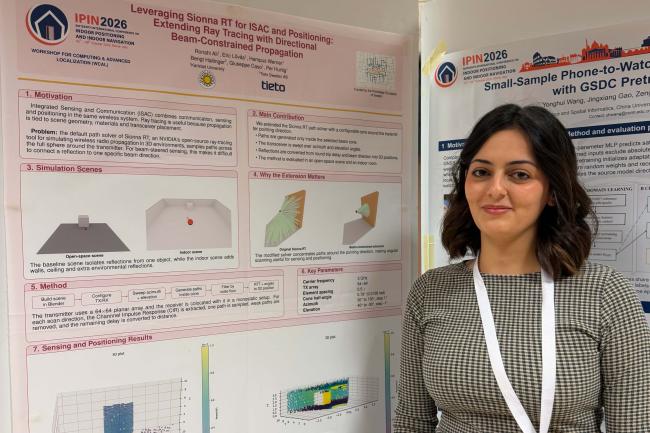
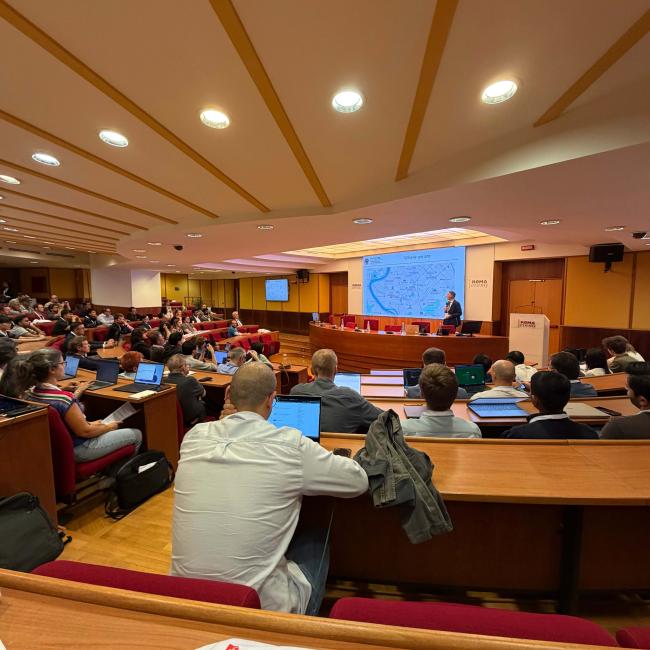
The paper was subsequently accepted for presentation at the prestigious IPIN 2026 (Indoor Positioning and Indoor Navigation) conference in Rome, held from 5 to 8 October, where Ronahi Ali presented the work in a poster session.
“It was a very enjoyable and educational experience. I had the opportunity to present our work to researchers from different parts of the world, discuss our findings and receive valuable feedback. Many people were interested and came over to ask questions about our research,” says Ronahi Ali.
“It was also fascinating to attend other presentations and learn more about the latest research in positioning, navigation and communications. It was particularly rewarding to represent both Karlstad University and Tieto at an international conference. And of course, it was wonderful to experience Rome as well.”