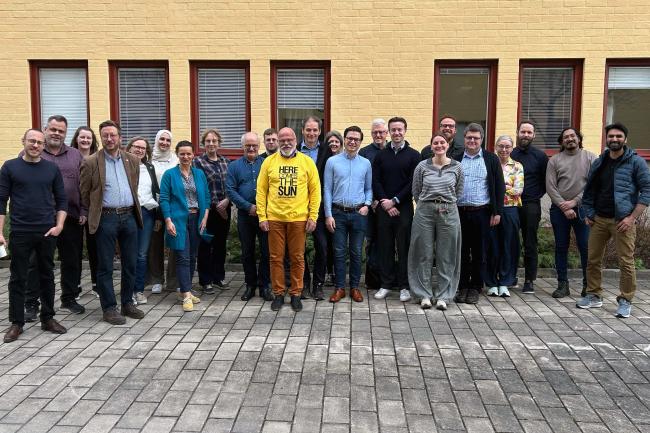
On April 14–15, the EXACT research school held its spring meeting, an opportunity for doctoral students and partner companies to exchange knowledge and experiences. Day one focused on leadership and entrepreneurship, while day two centered on the doctoral projects and the participating companies.
Bernt Svensson, former Head of Products at Absolent prior to his retirement and a member of the EXACT board, gave a lecture on leadership and the difference between a leadership role and an expert role. The doctoral students reflected on these different roles and shared their concerns, including workload and relationships with colleagues, which make many hesitant to take on a leadership position. A survey by the trade union Ledarna on young managers highlights the same issue: many people aged 18–35 do not want to become managers, for the same reasons expressed by the doctoral students.
“It is common to believe that you must be an expert in everything when you become a manager, but that is impossible. The role of a manager is to be an expert in leading people.” says Bernt Svensson.
The purpose of the first day was to give the doctoral students a broader view of the opportunities available after completing their studies.
Doctoral and Company Presentations
The second day was devoted to presentations of the doctoral students’ research, followed by presentations from the partner companies.
Carl‑Magnus Brandens conducts his research together with Lixea. Lixea operates an ionic liquid–based (Ionosolv) biorefinery process in which biomass is fractionated into several valuable material streams—cellulose, lignin, and derivatives from hemicellulose.
Björn Öman conducts his research in collaboration with Nordic Paper in Säffle. His research focuses on making the production of greaseproof paper (fat- and oil-resistant paper) more energy-efficient.
Zaeem Aman’s research focuses on how paper fibers degrade during drying, a process known as hornification. Hornification causes recycled fibers to lose strength and therefore limits the number of times they can be reused, which in turn restricts the possibilities for a circular bioeconomy. Zaeem conducts his research in collaboration with Rottneros.
Elise Meur’s research examines how recycled cotton fibers can replace wood in viscose production, thereby contributing to more sustainable textile manufacturing. Elise conducts her research in collaboration with Circulose.
The partner companies Stora Enso, Blue Ocean Closures, and Absolent also presented their operations and how they relate to research within EXACT.