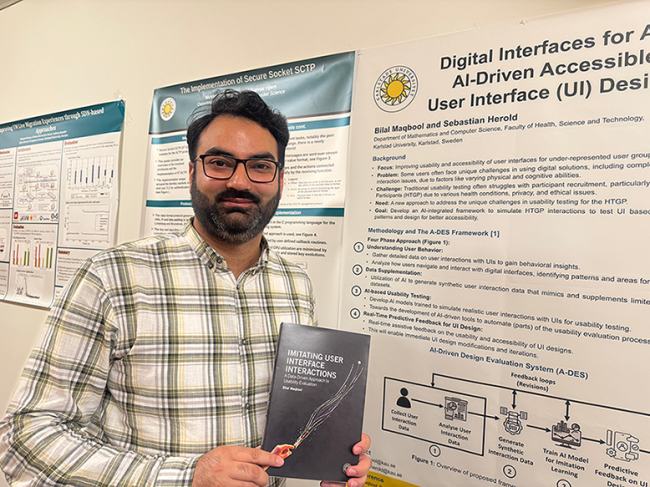
How can apps and digital health services become easier to use for older adults and people with motor impairments? In his doctoral thesis, Bilal Maqbool in Computer Science has developed an AI-based method that can imitate user interactions and has investigated why usability testing is often a challenge.
”To create user-friendly systems, developers need to test their products with real users. This can be difficult, especially when the target group includes people with conditions such as Parkinson’s disease, reduced motor function, or other health challenges. Recruiting participants, obtaining ethical approvals, and conducting repeated tests require both time and resources”, he says.
AI that learns from people
Bilal Maqbool’s thesis is based on the idea of creating an AI tool that can act as a “virtual user.” Instead of involving real people in the earliest stages of development, developers could let the AI mimic user behaviors to test an interface and identify problems before the system reaches end users.
”The problem is that it is not easy to get people to participate in usability testing, especially when it involves individuals with health conditions or other special needs”, he says.
To explore this possibility, the research focused on a specific user group: older adults with unsteady or shaky hands. This group was chosen because they often face challenges when using small buttons, complex menus, or sensitive touchscreens.
Through user testing, the researchers collected data on how people in this group interacted with smartphones. They studied, among other things, how users tapped the screen, what kinds of errors occurred, user continuous motor control, and which parts of the interface caused difficulties.
The method is based on so-called imitation learning, a form of machine learning in which AI learns by observing human behavior.
”The principle is similar to how children learn. By observing their surroundings and seeing how others act, a child gradually builds an understanding of the world. In the same way, the AI model is trained by analyzing data from real users. The goal is not to create an AI that uses an app perfectly. On the contrary, it should imitate human behavior as realistically as possible. We want it to use software the same way a human would, including the mistakes that may occur”, explains Bilal.
If people with shaky hands often miss small buttons or accidentally tap the wrong place, the AI toolshould be able to make similar mistakes. In this way, developers can gain a more realistic understanding of how their systems will work for the intended user group
Bilal Maqbool does not see the AI as a replacement for real user testing. Instead, the idea is that it should serve as support in the early stages of development.
By letting the AI test different versions of a system, developers can identify many issues before moving on to tests with real users. This can reduce both costs and development time while improving quality. Interviews with companies and other actors in healthcare and technology also show interest in such solutions, as many organizations consider usability important but lack the time, resources, or access to the right user groups to conduct extensive testing.
Accessibility benefits everyone
An important insight from the research is that accessibility does not only benefit people with specific needs. Solutions that are easier to use for older adults or people with motor impairments often improve usability for everyone. Larger buttons, clearer information, and simpler navigation can be just as valuable for someone using a phone while walking as for someone with a permanent disability.
”When we make technology more accessible for one group, we often help many more users at the same time. At its core, it is about making everyday life easier. The research project shows that AI can become a valuable tool for creating more user-friendly digital services. Although the technology does not replace real users, it can help developers identify problems earlier and thereby contribute to better and more inclusive solutions”, he concludes.
- Read Bilal Maqbool's thesis: ”Imitating User Interface Interactions: A Data-Driven Approach to Usability Evaluation”.