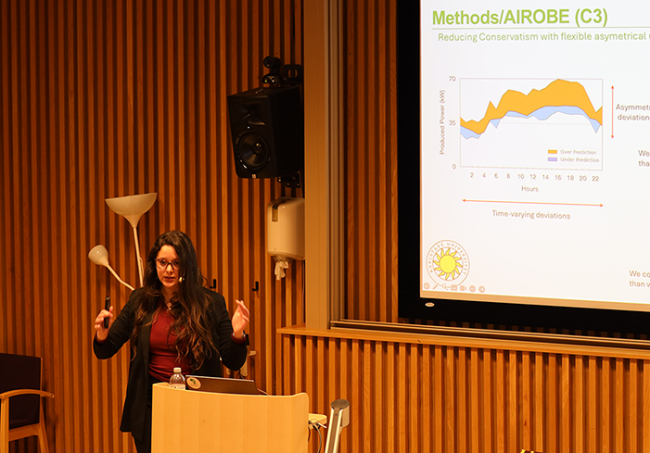
As more households and buildings both produce and consume energy, for example through solar panels and electric vehicles, energy systems require flexible solutions. This is what Amal Nammouchi has explored in her dissertation, where the research lies at the intersection of artificial intelligence and energy.
What is AI for applied energy?
“AI in applied energy is about the challenge of operating power systems reliably as they become increasingly decentralized. By ‘decentralized,’ we mean that energy systems are no longer controlled only by large, central power plants. Instead, end users become so‑called prosumers, they both consume and produce energy. For example, people may have solar panels on their roofs, home batteries or electric cars. They can import electricity from the grid or export surplus electricity back to it. This makes the system more distributed and closer to the end user. At the same time, it makes energy systems more complex. The growing integration of renewable energy, batteries and flexible loads creates new challenges. The central question therefore becomes: how can we manage these systems efficiently and reliably?”
What results have you seen in your research?
“The results show that cooperation within energy communities can provide both economic and social benefits compared to traditional models. At the same time, the research highlights a clear need for better support for users in this new energy reality. Another important part of my work is the role of the end user. Users are becoming increasingly important in the energy system, especially through concepts such as demand response, where electricity use can be adjusted during, for example, periods of high load. Yet many users lack tools to understand their energy use and production. That’s why I work with interfaces that help users understand, interact with and make decisions together with automated energy management systems.”
How can we manage energy smartly?
“At a basic level, this can start with a single building and developing models to control its energy use. But the concept extends to larger scales, such as energy communities or microgrids. In these systems, energy is not only consumed individually, it can also be shared. For example, a building with surplus energy can share it with another building experiencing a deficit. My work focuses on developing model‑based, intelligent energy management systems that can handle this complexity. An important aspect is managing uncertainty. Unlike traditional electricity production, renewable energy such as solar power depends on weather conditions that are difficult to predict. Therefore, we use forecasts to estimate how much energy will be produced and consumed. In short, I develop intelligent energy management systems for decentralized, renewable energy communities, with a focus on making them reliable and efficient despite uncertainties such as weather variations and changing user behavior.”
Would you like to share more about why you think AI is important in climate issues?
“My interest in the field comes from a broader focus on AI for societal benefit, which gradually developed into an interest in AI for climate and sustainability. The energy sector is one of the largest sources of CO₂ emissions globally. Transitioning to renewable energy is crucial, but it’s not enough to simply install solar panels. We must also optimize how energy is produced, distributed, and used. As energy systems evolve and markets become more complex, intelligent and efficient energy management becomes essential to enable the energy transition. This is what has driven my interest further in the field.”
Awarded the SEB Innovation Scholarship
SEB is awarding its innovation scholarship for the second year to young entrepreneurs with research‑based ideas, and Amal Nammouchi has been granted SEK 200,000 to develop her company Wattzo. With support from the Grants and Innovation Office and VFT – verification for growth at Karlstad University, the ideas have been developed, tested in pilot projects and led to a newly founded company. The company offers an AI‑based platform to optimize energy use and the scholarship will now support continued development both in Europe and internationally.