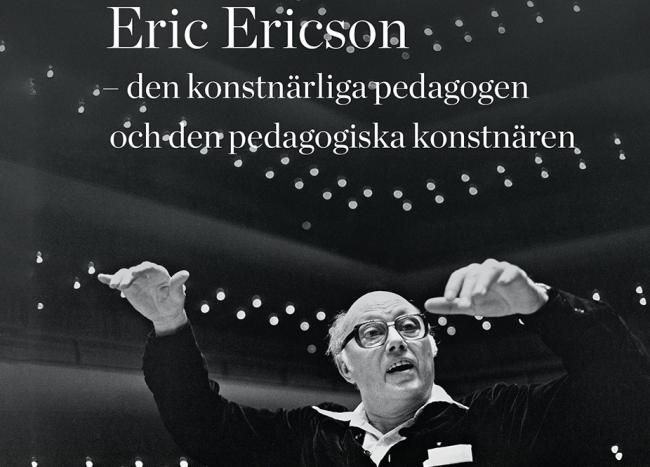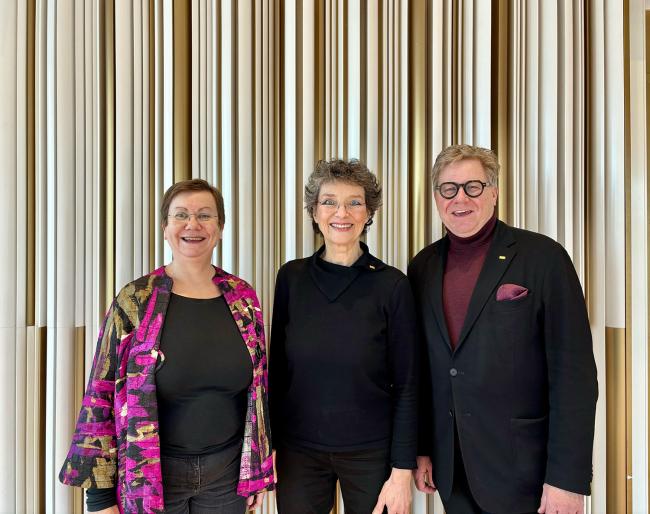
Who was the conductor and choir leader Eric Ericson? In the newly published book Eric Ericson – The Artistic Educator and the Pedagogical Artist, his life’s work in Swedish choral music is described. One of the co-authors is Pia Bygdéus, who in her everyday work is, among other things, a teacher and researcher in music education at the Ingesund School of Music, Karlstad University.
Additional authors are Cecilia Rydinger and Per-Henrik Holgersson, and the book has been produced within the research project Eric Ericson – Musical Knowledge Development, funded by the Marcus and Amalia Wallenberg Foundation, with the Royal College of Music in Stockholm acting as the grant administrator.
“We are three conductors, from the same profession but with different backgrounds, who are the authors,” says Pia Bygdéus. “The target groups for the book include students, teachers, and practitioners, and it contains interviews with choir singers, choir conductors, composers, and educators, as well as focus group discussions with Eric’s former students—now themselves successful conductors and educators—which provide a deeper understanding of him. Eric Ericson’s own words about the development of choral art and choral life are given considerable space, and a unique compilation of his pedagogical work is presented here for the first time.”
Eric Ericson is known for his leadership of choirs such as the Swedish Radio Choir, the Eric Ericson Chamber Choir, the Royal College of Music Chamber Choir, and the Orphei Drängar male voice choir. The book contains many accounts of how he moved seamlessly within both artistic and pedagogical work, characterized by curiosity, openness, and a strong desire to develop choral art. Singing in a choir is something many Swedes engage in, and today it is considered one of the largest popular movements in the country. Would you say that Eric Ericson is one of the choir leaders who laid the foundation for this?
“He had a strong influence during the 20th century. He cared about everything from various amateur choir contexts to professional choirs.”
You teach and conduct research in music education at the Ingesund School of Music and are also the research leader of the interdisciplinary research group Singing Health in Schools – A Societal Concern, as well as serving as a research secretary at the Royal Swedish Academy of Music. It has been scientifically proven that singing benefits well-being—do children and young people sing too little in schools?
“Yes, we have found that in teacher education, training related to the body, voice, singing, vocal technique, role modeling, and what happens in the body when you sing has been given less priority. Children have the right to their body, voice, and artistic education in school, but as this has been reduced in teacher education, the time and opportunities for singing in schools have also decreased. What happens when pupils in grades 2 and 3 sing for fifteen minutes a day in their classroom? Within Singing Health in Schools – A Societal Concern, 241 pupils, school leaders, music teachers, and teachers from four different schools have now participated in a five-year research project and done exactly this. The results will be presented at the research group’s upcoming public seminar on October 13 at Ersta Cultural Centre, with the entire interdisciplinary research group participating.”
Like Eric Ericson, you have conducted orchestras and choirs across various genres, including newly written chamber operas, and have performed in and conducted big bands, orchestras, and choirs in different venues and concert settings. He had a very personal style—do you also have your own style, and how would you describe it? How do you bring out the best in a choir—what is the secret?
“The personal dimension is your professional identity, and that is what creates something unique in every musician, conductor, and performer. You need to see and hear everyone in the room, regardless of the size of the group you are working with. It is also important to dare to let go in the space in between. When you are at home preparing and practicing, it is you, the score, and the instrument, but when you enter a rehearsal room or concert hall, you collaborate with many people. You need to place both the human being and the music at the center and stay present in the moment. Without the human being, there is no music—and with the music at the center, there is music. It is about trust between me and the musicians, in that shared space, and when we achieve that, that is when it happens. That is when find the right groove!”