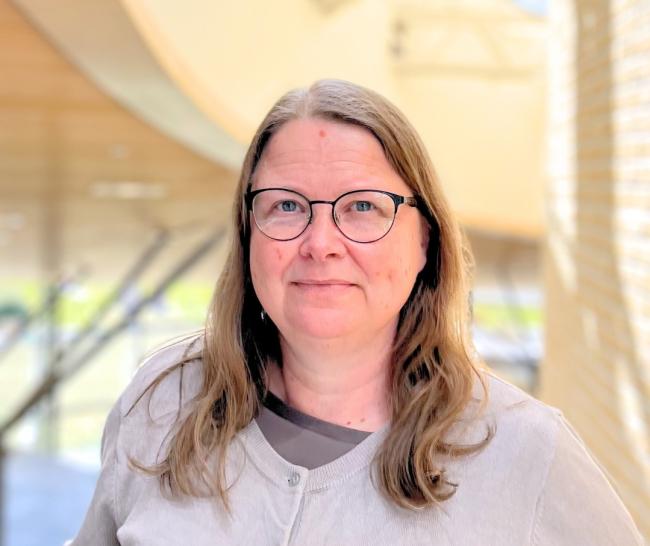
What kind of support do people with acquired brain injury and their kin receive from healthcare social workers? And how do they experience that support? These are the main questions in doctoral student Monika Högsnes’ licentiate thesis at the CRS Research School in Sustainable Societal Transformation.
Monika Högsnes is a social worker with a Master’s degree in Social Work. She began her doctoral studies at Karlstad University in spring 2022. Alongside her research, she works as a healthcare social worker at the neurology and rehabilitation clinic at Central Hospital in Karlstad. Her licentiate studies have been funded through a joint initiative by Region Värmland and Karlstad University, and the programme is now close to completion.
Her final licentiate seminar will be held in August. The first article from the project has already been published in the *International Journal of Qualitative Studies on Health and Well-being*.
From clinical work to research
In her licentiate thesis, Monika explores healthcare social work from the perspective of patients and kin. Her interest in the topic comes from both her professional experience and earlier research.
– How patients and kin experience support is something we still know quite little about. There is a fair amount of research on the role of healthcare social workers, but much less from the users’ point of view. That was my main reason for starting this project. In my work at the neurology and rehabilitation clinic, and previously in adult rehabilitation, I have met many people with acquired brain injury. That is why I chose to focus on this group and their kin.
The thesis is based on two interview studies with a total of 33 participants from ten counties in Sweden. Of these, 23 are people with different types of acquired brain injury and 10 are kin. The findings have been developed into two articles.
The first article, which is already published, examines how participants experience healthcare social workers and the support they provide. The second article is still in manuscript form and focuses on experiences of participation and access to support. It is expected to be submitted to a journal within the next few weeks.
Practical and informational support are also important
– The first study shows that psychosocial support includes several different parts, with emotional support standing out as especially important. At the same time, participants found practical and informational support harder to access, even though they saw it as just as important. In some cases, this kind of support was even necessary before emotional support could be helpful.
The study also shows that support needs to be available both early on and later in the process. Even if a person is not ready to receive support during an acute crisis, it is still important that support is offered, so they know where to turn when they are ready.
Not only support – but the right support
The second study shows that access to healthcare social work support, and the opportunity to take part in that support, vary between individuals. Many participants describe it as a struggle to find the right kind of help. There is also a risk that the needs of both people with acquired brain injury and their kin are overlooked.
Monika hopes the results will help improve person-centred support from healthcare social workers for both patients and their kin.
After the licentiate seminar, she will continue sharing knowledge from the project, including at a healthcare conference at Örebro University this autumn. In the long term, she hopes to continue researching this field in a full doctoral thesis and also include the perspectives of healthcare social workers themselves.
The published article is available here: Hospital social work in acquired brain injury care: patients' and kin' experiences and perspectives on psychosocial support