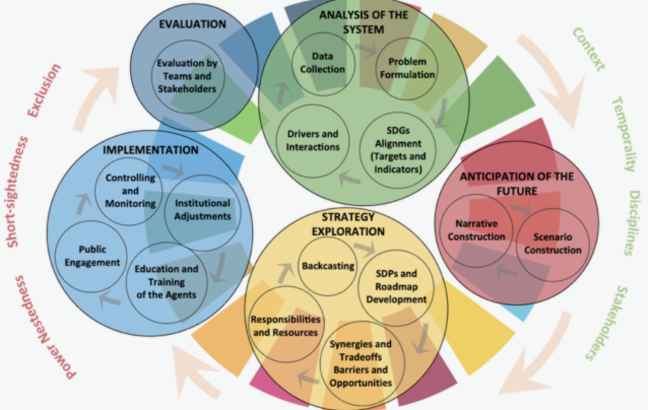
A new scientific publication led by Karlstad University climate researcher Avit Bhowmik presents a pluralistic framework designed to guide policy action and grassroots sustainability transformations across all scales—from local communities to global initiatives.
The UN Agenda 2030 for Sustainable Development offers a shared blueprint for progress, built around the core promise to “leave no one behind.” Yet despite their importance, the Sustainable Development Goals (SDGs) remain global, ambitious, and often difficult to apply in specific local contexts.
This challenge raises important questions
How can coffee farmers in Costa Rica align their transformation processes with the global SDGs? How can global initiatives such as the Sustainable Development Solutions Network benefit from agroforestry projects in Ghana or Bangladesh? And how can people living in widely different regions and contexts connect their work to a global agenda?
In the newly published article, Bhowmik and colleagues address these questions by systematically reviewing sustainability transformation projects across multiple scales. The researchers examined strategies, collaborations, and narrative shifts reported in the literature to identify what successful projects have in common. The findings are synthesized into a pluralistic framework that outlines:
- Five consecutive phases for implementing SDGs and SDG targets at any scale—from problem formulation to project evaluation.
- Four enabling factors that support SDG implementation: context, temporality, disciplines, and stakeholders.
-
Three hindering factors—power nestedness, short‑sightedness, and exclusion—that may impede progress at different spatial scales.
“Our goal was to understand how sustainability transformations actually happen in practice,” says Avit Bhowmik. “By bringing together insights from across the world, we hope this framework can help local communities and global actors work toward the SDGs in ways that make sense for their own realities.”
- The article is published open access in Sustainability:
https://www.mdpi.com/2071-1050/18/3/1459