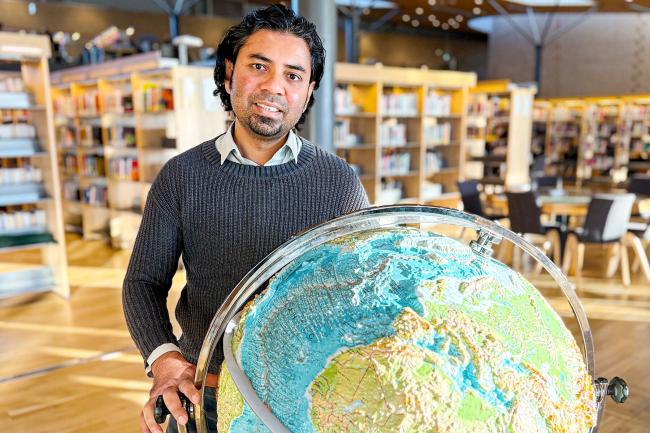
The world is not short of knowledge about climate change. The real challenge is turning that knowledge into action. This is one of the key messages that Avit Bhowmik, Assistant Professor in Risk and Environmental Studies at Karlstad University, will bring to the international stage when he participates in several official events during the UN Climate Change Conference COP31 in Antalya, Türkiye, on 15–20 November.
This year’s climate conference will bring together researchers, policymakers and organisations from around the world to discuss how science, policy and international cooperation can accelerate climate action. At COP31, Avit Bhowmik will contribute perspectives from his research on sustainability transformations and the challenges that arise between scientific knowledge, political ambition and implementation.
“One of the major challenges in climate action is that having scientific knowledge and ambitious targets does not automatically lead to transformation. We also need the institutional, political and societal capacity to act on that knowledge. This means strengthening collaboration, developing leadership, building trust and creating opportunities for people and organisations to experiment, learn and drive change,” says Avit Bhowmik.
Bringing regional experience to a global climate discussion
Avit Bhowmik’s participation at COP31 is closely connected to research and development work currently underway in Värmland. Through the LOKEN project (Local Energy Management Värmland), Karlstad University works together with Glava Energy Centre and regional partners to strengthen the ability of municipalities, businesses and other stakeholders to plan and implement the energy transition.
The project focuses on areas such as energy communities, energy leadership and energy planning. A central insight is that technological solutions and infrastructure investments are not enough on their own. Successful energy transitions also require organisations, institutions and collaborative structures that enable people to participate in and shape the transition.
“Experiences from regional energy transformation are highly relevant to the global climate discussion. Whether we are talking about energy communities in Värmland or climate implementation internationally, the underlying challenge is similar: how do we bring different actors together, develop a shared understanding of complex challenges and build the capacity to implement change?” says Avit Bhowmik.
Building the capacity to transform
A key concept in Avit Bhowmik’s research is transformation capacity: the ability of individuals, organisations and institutions to understand complex challenges, collaborate across boundaries and turn shared ambitions into concrete action.
His research also explores how participatory approaches, future visioning and gamification can strengthen this capacity. By creating opportunities to explore alternative futures, discuss difficult decisions and experiment with possible solutions, these approaches can help build knowledge, agency and collective action.
Linking climate science and implementation
Through his involvement in international research networks and climate policy processes, including Future Earth and the Analysis, Integration and Modelling of the Earth System (AIMES), Avit Bhowmik works at the intersection of climate science, policy and societal transformation.
At COP31, he will bring these perspectives into the international discussion on how climate action can become more resilient and effective.
“Climate science must increasingly connect knowledge generation with an implementation agenda. We need to invest not only in technological solutions and scientific research, but also in the capabilities, relationships and institutions that make transformation possible. Ultimately, resilient implementation depends on our collective capacity to act and adapt,” says Avit Bhowmik.