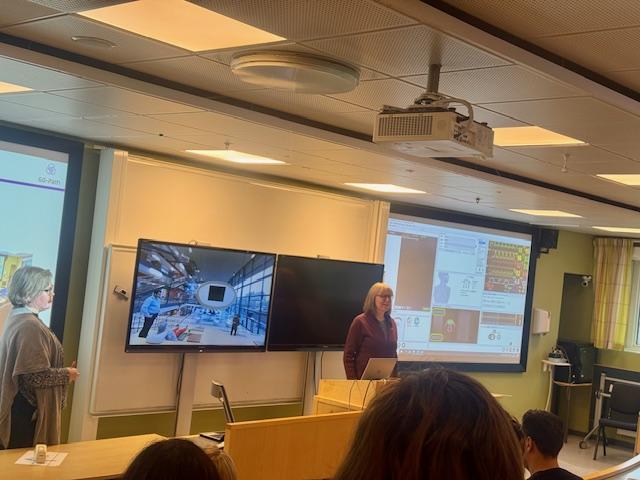
The 6G-PATH project (6G-Pilots and Trials Through Europe), involving both Computer Science and Nursing recently presented its technology to an audience during a fully attended seminar.
The aim of the project is to advance education in health and medical care by using communication technologies such as 5G and 6G, combined with Extended Reality (XR) and Virtual Reality (VR).
The goal is to make healthcare education more realistic and flexible, for example through VR and remote training where simulators and equipment can be used outside traditional classrooms. The technology can also support healthcare personnel in acute situations by allowing experts to join remotely.
“Advanced mobile technology enables interactive training in environments that previously were difficult to recreate in the classroom,” says Anna Brunström, Professor of Computer Science and project leader at Karlstad University.
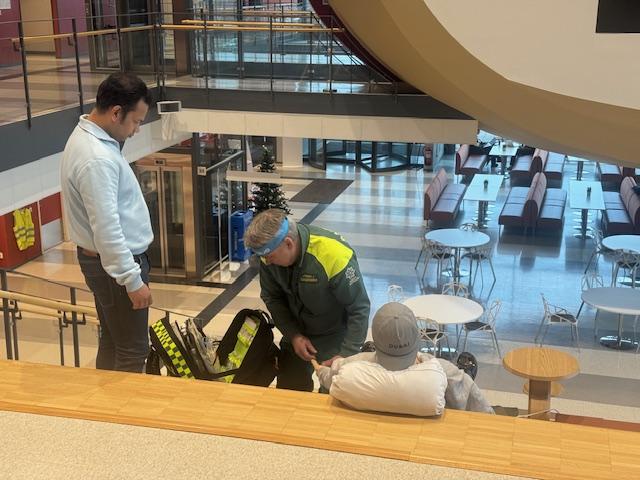
Jörgen Jansson, Senior Lecturer in Nursing, carried out the practical tests in the role of an ambulance nurse:
“Our role is to act as a bridge between the technical and the pedagogical aspects, and we strive to make the technology understandable and useful in teaching. We conducted a scenario where I simulated an ambulance nurse, imagining an ambulance parked outside. We used the SimMan manikin, who had briefly fainted due to heart problems (arrhythmia). The patient was recovering, and I performed a standard assessment.”
In the lecture hall, participants followed the scenario on screens.
“I’m wearing a head-mounted camera so that viewers can see what I see. The screens also display vital parameters such as pulse, blood pressure, and oxygen saturation. I’ll be speaking to SimMan, who in the scenario is a 25-year-old student who has fainted.”
What does the technology contribute to the training?
“In the ambulance programme, we usually train in a hospital-like environment. In reality, we work in homes, in ditches, or at accident sites—not in clinical environments. This project makes the exercises more realistic and more similar to the environments we are used to,” he says.
“The technology allows us to train while simultaneously showing in real time what is happening during the exercise. The purpose of 6G-PATH is to promote the development and integration of 5G/6G technology within a number of concrete use cases. We will evaluate both the technical performance and how these new solutions can contribute to user value, and it is an exciting opportunity to work together with Nursing to assess how XR and 5G/6G technology can contribute to developing education in Health,” concludes Anna Brunström.
Facts
The EU has granted 12.571 million euros, of which Karlstad University’s share is 566,250 euros. Twenty-six partners from 13 countries participate, and the project will run for three years. The project was also on the IVA's 100 lists.