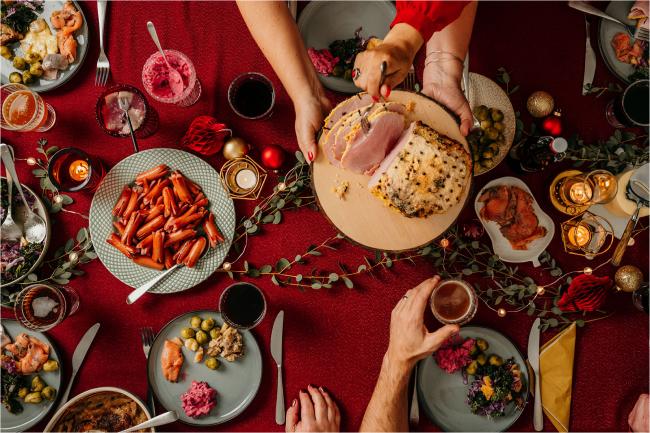
Christmas is a time for togetherness, traditions and generous meals – but also for increasing amounts of food waste. At the same time, a national debate is under way in Sweden about stricter targets to halve food waste. Researchers at Karlstad University therefore encourage people to think sustainably ahead of the Christmas and New Year holidays. Small changes in everyday habits can reduce both climate impact and household costs.
“If you want to avoid feeling guilty about throwing food away – because a lot is wasted during the major holidays of the year – it is wise to think before you shop,” says Fredrik Wikström, professor of Environmental and Energy Systems. “If you go to the supermarket without a shopping list, tired and stressed, it is easy to buy more than you will consume. Retailers want to sell, and they are experts at getting us to buy a little more than we intended – often through bulk packs and special offers, which in the long run becomes more expensive if we end up not eating all the food.”
Together with his colleague Helén Williams, associate professor of Environmental and Energy Systems, he researches how food waste can be prevented – for example, through smarter packaging solutions.
Today’s food packaging protects food effectively, but only as long as it remains unopened.
“For many fresh products, such as bagged salad, it is often better to buy two small packs rather than one large one,” says Helén Williams. “Think about which products you tend to throw away – for those, smaller packs may be a better choice. Focus particularly on animal-based products, as they have the greatest environmental impact. Making sure these end up on your plate rather than in the bin is a good place to start.”
Why changing habits is so difficult – and what you can do
Even though most people know that food waste is bad for both the environment and the household economy, it is hard to break established habits. This is not necessarily due to a lack of willingness, but to how the brain works, explains Charlotte Bäccman, associate professor of Psychology.
“The brain likes shortcuts. Old habits run on autopilot to save energy. To change a behaviour that does not immediately feel rewarding, we need to be more conscious and attentive in certain situations – which requires more mental effort than we often realise.”
She highlights impulse purchases in the supermarket as an example. Hunger, stress and special offers make it easy to fall back into old habits. At home in the kitchen, we also need to become more aware of how much food is actually needed. Christmas often involves time pressure and stress, which makes planning even more important.
“Start by calculating portions more carefully, for example, how much food is needed for a Christmas buffet – buffet portions differ from regular dinner portions,” says Charlotte Bäccman. “Also be critical of supermarket offers – the ‘saving’ is not always as great as it seems. It is easy to be triggered by the feeling of getting a bargain. New habits require time and energy, so it may be wise to start writing shopping lists and planning to cook the right amount of Christmas food well in advance.”
The global impact of food
“Food production currently accounts for around one third of humanity’s climate impact, from production to consumption,” says Helén Williams. “At the same time, one third of all food produced is thrown away, and food production is one of the main drivers of global species loss – through, for example, the use of pesticides and the clearing of rainforest. Small changes in our households can therefore make a big difference.”
Researchers’ tips for reducing food waste
- Plan before you shop. Make a shopping list based on what you actually need – and stick to it. Avoid shopping when hungry or stressed, and be sceptical of bulk packs and ‘buy more’ offers.
- Buy the right amount. Choose pack sizes according to your needs and only buy larger quantities if you know everything will be used before it spoils.
- Understand date labelling. ‘Best before’ is not the same as ‘use by’. Smell and taste the food before throwing it away.
- Cook appropriate quantities. Become more portion-aware by calculating how much food is actually needed for a Christmas buffet.
- Take care of leftovers. Send guests home with food after Christmas and New Year dinners – shared joy and less waste.