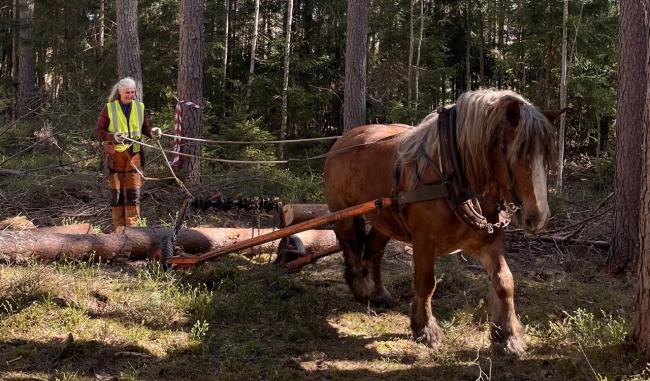
The observant person may have noticed that wind-felled trees have been cut up in SKAUgen, the wooded area below Building 9, on several occasions over the past few weeks. Cecilia Berntsson and her team at Bernttek have been on site helping us with the work. This effort is part of the ongoing work to care for the woodland area around the university in a careful and long-term sustainable way.
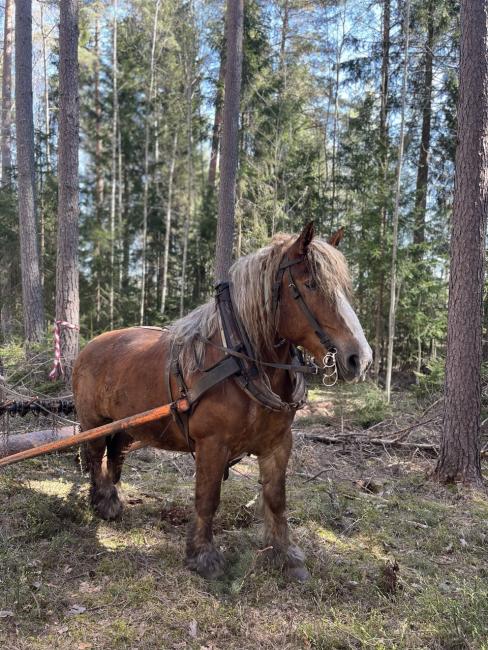
During the day, Cecilia has taken care of removing and clearing away the cut-up trees. She has been assisted by her 13-year-old colleague – the working horse Docka. Together, they have transported the trees further within the area in a way that is gentle on both the ground and the surrounding environment.
Cecilia’s company specialises in various types of nature-based services, where horse-drawn timber extraction is an important element. In forest clearing, working horses such as Docka can be a good alternative to traditional machinery. A horse can move through the terrain with less impact on the ground, which is valuable in sensitive environments where unnecessary disturbance to vegetation and soil life should be avoided.
From dead wood to new life
Docka’s task has been to transport the trees to places where they can be used to create habitat piles. A habitat pile consists of dead wood that is placed in nature to promote biodiversity. Although dead wood may sometimes be perceived as something that should be cleared away, it is in fact a very important resource in the forest. Many insects, fungi, mosses, lichens and other wood-dwelling species depend on such environments for their survival.
Which species can thrive in a habitat pile is influenced by factors such as location, size, wood dimensions, tree species and exposure to sunlight. By creating variation in how the wood is placed, it is therefore possible to contribute to a wider range of habitats. In this way, the wind-felled trees are not only something that needs to be cleared away, but also an asset to the forest ecosystem.
The work in SKAUgen is therefore both about making the area more accessible and about strengthening the natural environment close to the university. By making use of the wind-felled trees and using them as habitat piles, new habitats are created that may, over time, benefit biodiversity in the area.
So the next time you take a pleasant walk along the forest trail, you may see the results of Cecilia and Docka’s efforts in the form of improved accessibility and more life in SKAUgen.