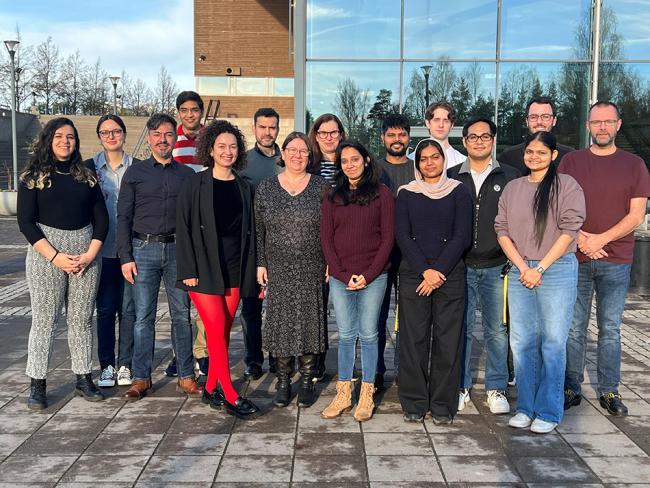
Research on organic solar cells at Karlstad University is now taking another step forward, thanks to support from WISE, the Wallenberg Initiative Materials Science for Sustainability.
The sun is an enormous resource and increasingly important for electricity production. Roughly one to two hours of sunlight hitting the Earth corresponds to the entire annual energy consumption of humanity. At Karlstad University, researchers are working on developing more efficient organic solar cells, which offer several advantages such as flexibility and low production costs.
– It is an invaluable opportunity for our research group at Karlstad University to participate in the WISE programme and join the dynamic materials research community in Sweden to make emerging technologies more sustainable, says Ellen Moons, professor of physics and leader of the research group. We hope to continue this journey for many years to come.
Saurabh Pareek focuses on making the next generation of solar cells more efficient, more durable, and more environmentally friendly.
– Through WISE, I have had the opportunity to come to Karlstad University as a postdoc, says Saurabh Pareek. At my core, I am a materials scientist focused on making the next generation of solar cells more efficient, more durable, and more environmentally friendly. My journey began in India, where I completed my PhD at the Indian Institute of Technology Delhi, studying new nanomaterials for solar energy. Over time, I became fascinated by how small changes at the molecular level can dramatically improve how we capture sunlight. I enjoy working at the intersection of materials science, renewable energy, and societal benefit.
An energy source that is affordable and accessible to more people
The research group focuses on improving organic solar cells, a solar cell technology based on carbon‑based materials instead of silicon. These solar cells are lightweight, flexible, and can be printed on materials such as plastic or paper. This opens the door to many new applications: solar‑powered tents, portable electronics, or coatings that can harvest energy from almost any surface.
To make the technology practical, two challenges must be solved: the durability of the solar cell and sustainable manufacturing methods. Instead of using harmful chemicals commonly used in solar cell production, new methods are being developed to produce high‑performance organic solar cells using environmentally friendly solvents such as alcohol or water. In this work, the group collaborates with Professor Ergang Wang at Chalmers. The ambition is that, through understanding how materials interact at the nanoscale, it will be possible to produce solar cell technology that is cheaper, safer, and easier to manufacture — enabling renewable energy to reach more people and more places.
– We are developing new ways to create the active layers in the solar cell, says Saurabh Pareek. This makes it possible to control the nanostructure, especially the donor and acceptor layers, so that the device can absorb light more efficiently and the material degrades more slowly. At the same time, we eliminate toxic solvents from the process, making the entire production chain safer for people and the environment. At the core of our research is understanding how molecular structure, processing methods, and solar cell performance are connected — and using that knowledge to build better solar cells.
WISE, the Wallenberg Initiative Materials Science for Sustainability
WISE is Sweden’s largest investment in materials science with a clear focus on sustainability. The initiative aims to develop the next generation of materials that are not only high‑performing but also gentle on the planet’s resources and environmentally sustainable throughout their entire life cycle. WISE brings together researchers across Sweden to address major global challenges: clean energy, circular materials, reduced pollution, and efficient resource use. The vision is to look beyond immediate performance and instead consider how materials are produced, used, and what happens when they reach the end of their life cycle. The programme supports collaboration between universities, industry, and international partners, helping ensure that scientific discoveries can eventually become real‑world solutions.
– For researchers like me, WISE provides the environment, expertise, and infrastructure needed to explore new ideas that can have measurable impacts on sustainability, says Saurabh Pareek. It has also given me the opportunity to conduct experiments at the MAX IV synchrotron facility in Lund and at Solaris in Poland. I have participated in several WISE initiatives, including networking days, study visits, and synchrotron school.
– Being part of this initiative means contributing to a future where advanced materials and green technology go hand in hand. Going forward, I look forward to exploring new opportunities to contribute to sustainable energy technology. My long‑term ambition is to establish myself as an independent researcher in organic electronics, an area with enormous potential to create flexible, affordable, and environmentally friendly solutions for everyday use. Whether through academic collaborations or innovations that benefit society at large, I hope to help bridge the gap between advanced research and real societal impact.