What if your heat pump knew when you were about to take a shower or use large amounts of hot water? It could then produce hot water at the right time instead of heating unnecessarily. This idea lies at the heart of the research conducted by industrial PhD student Manal Rahal at Thermia, where machine learning is being used to make heat pumps smarter and more energy efficient.
Today, many heat pumps are controlled using fixed rules and pre-set threshold values. The problem is that they do not take into account the fact that household hot water consumption varies over time. A family that showers early in the morning has different needs from a household where most people shower late in the evening. When a heat pump fails to understand these patterns, it can result either in unnecessary energy consumption or an insufficient supply of hot water when it is needed most.
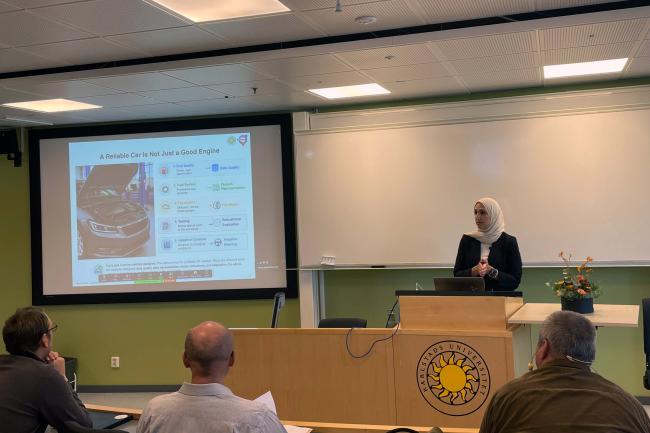
In her licentiate thesis, Data-Centric Machine Learning for Reliable Industrial Systems, Manal Rahal, an industrial PhD student within the EXACT Research School, investigates how machine learning can be used to predict household hot water demand and thereby control heat pumps more efficiently. The aim is to move from today's reactive control strategies to a more predictive and demand-driven mode of operation.
“The focus of my research is to use machine learning to make heat pumps smarter. By learning how a household uses hot water, the system can predict future demand and adjust production accordingly,” says Manal Rahal.
Learning Household Habits
The research project is based on data collected from Swedish households equipped with heat pumps. By analysing large volumes of sensor data, the algorithms can identify patterns in hot water consumption and detect recurring events such as showers.
In her thesis, Manal Rahal presents a system that combines predictive models with anomaly detection methods. Together, these create a kind of personalised calendar of a household’s hot water usage. This enables the heat pump to prepare for periods of high demand while avoiding unnecessary heating when demand is low.
The research findings show that the machine learning model known as LightGBM achieved both higher accuracy and significantly shorter computation times than several advanced deep learning models. The model was between three and four times faster to train while also providing more accurate forecasts of hot water consumption.
Potential to Lower Energy Costs
Heating and hot water account for a substantial share of energy consumption in many homes. According to Manal Rahal, there is therefore considerable potential to reduce both energy use and electricity costs through smarter control systems.
“If a heat pump can produce hot water at the right time instead of operating according to fixed rules, we can reduce energy consumption without compromising comfort,” says Manal Rahal.
The research is particularly relevant in an energy system that is becoming increasingly dependent on the efficient use of electricity. Smart heat pumps could not only lower costs for individual households but also contribute to a more sustainable energy system by reducing overall electricity demand.
From Research to Real-World Applications
The next step in the research is to test and further develop the technology in more realistic environments. One objective is to enable the models to handle even greater variations in user behaviour and to combine household data with information such as weather forecasts and electricity prices. This would allow heat pumps to make even better decisions about the most advantageous times to produce hot water.
EXACT
Manal Rahal is an industrial PhD student within the EXACT Research School at Karlstad University. Her research at Thermia focuses on how heat pumps can become more energy efficient by using data and machine learning to control hot water production based on actual demand.
Explore the Research