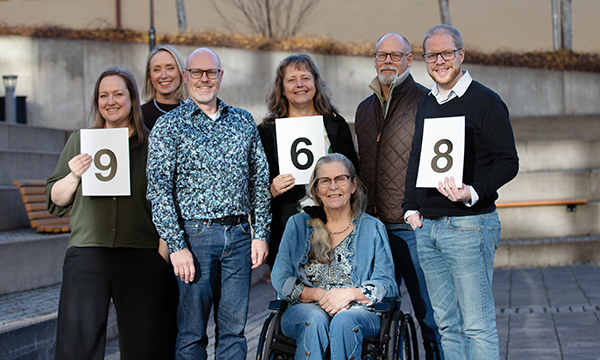

With 968 applicants competing for 30 places, the programme’s success is undeniable.
– We have found an educational model that works, says programme director Carin Andersson.
Karlstad Business School has offered the programme online since 2010, and interest has grown every year.
– Distance education has never been a temporary solution for us. It is something we have developed over a long period of time, says Programme Director Carin Andersson.
Part of the programme’s success lies in the idea that project management consists of two equally important perspectives. One perspective, the instrumental perspective, focuses on the tools needed to plan, execute, and evaluate one or more projects. The other, the human perspective, focuses on the tools required to help people collaborate, develop teams, and lead themselves and others.
– We see project management as a coin with two sides. We give both sides equal attention, says Carin Andersson.
Because students come from a variety of bachelor’s degree programmes and professional backgrounds, the programme offers a broad range of case studies, examples, and guest lecturers.
– For example, students learn tools for planning and managing both traditional and agile projects, as well as ways of combining these approaches, says Carin Andersson.
Study groups in every course help students understand different perspectives, navigate group development processes, and learn from one another.
– Studying online can feel lonely, but not with us at Karlstad Business School, explains Carin Andersson.
– As a student, you write your thesis independently, but you are never alone in the process. Even during the thesis course, you are part of a study group that meets regularly.
Teachers who dare to try new approaches
Each course is taught by at least two instructors. This allows teachers to continuously discuss their teaching methods and experiment with new approaches.
– We feel secure enough to experiment, and the students notice that, says Carin Andersson.
The programme is offered on a part-time basis, requiring approximately 20 hours of study per week, allowing students to combine their studies with work. These 20 hours are spent on scientific articles, recorded lectures, discussions and collaborative learning in study groups, as well as workshops and seminars with instructors, held in the evenings.
– What you learn in the evening can be put into practice at work the very next morning.
The programme’s alumni group on LinkedIn currently has 332 members, ensuring that connections continue long after graduation.
– In the alumni group, we can follow how our former students take on exciting new assignments and challenges. That is the best proof that the programme makes a difference, says Carin Andersson.
Learn More