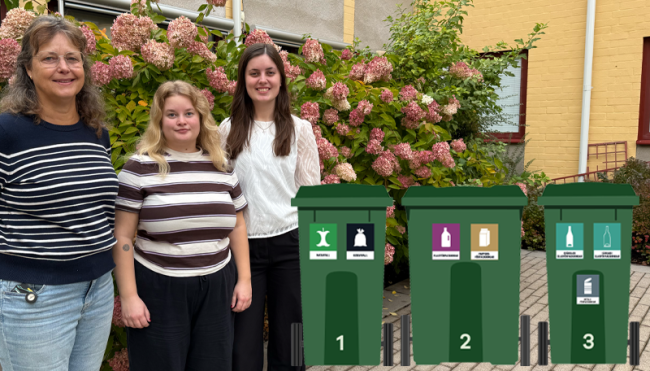

The introduction of new waste sorting bins in Karlstad Municipality has turned into a perfect learning opportunity for students enrolled in the Master's Programme in Project Management at the School of Business.
– This project contains many fascinating elements that fit perfectly with our programme, says John Johansson, lecturer in Business Administration at Karlstad Business School.
The project is something of a dream case for project management education. It is driven by legal requirements, affects people's everyday lives, and involves extensive logistics that must be carefully planned and executed.
– We received new waste bins at our house, and because I'm curious by nature, I looked into the project and realized that it has many aspects we can use in our teaching, says John Johansson.
Carin Andersson, Senior Lecturer in Information Systems and Programme Director of the Master's Programme in Project Management, immediately recognized the project's educational potential.
– When we do not have the opportunity to provide students with live cases, it becomes especially important that our cases are as realistic as possible. This project was therefore a perfect match. It may also inspire thesis topics and networking opportunities for our students.
The Home Sorting project illustrates the complexity of project work. It also employs a strategy designed to accommodate most households. The most challenging cases are placed on a special list and handled individually on a case-by-case basis. This creates an efficient approach for the majority of situations while still providing tailored solutions for the more difficult ones.
– It is also exciting that this is a local project, says John Johansson. And it is easy to find information about similar projects in other municipalities, since all municipalities in Sweden have been subject to the same legal requirements.
What are your expectations of this project?
– At the beginning of the autumn semester, our master's students participated in a seminar based on articles about stakeholder analysis and sustainability, which makes this project particularly relevant, says Carin Andersson. I also strongly believe in student participation and in the value of student perspectives for deeper learning.
– I hope students will see how both learning and planning play important roles in projects, says John Johansson. And that stakeholders are often far more numerous than one might initially assume.
– Another major benefit is that students get an unfiltered view of reality, continues John Johansson. They will encounter conflicting objectives and mistakes, but also solutions and lessons learned. We also believe they will discover that the tools they have learned during the master's programme are genuinely useful.
Different Components of the Home Sorting Project
Sustainability
Sweden is currently among the world's leading countries in recycling corrugated cardboard and paper packaging and also performs well in glass recycling. Plastic recycling, however, remains more challenging. An important objective of the project is therefore to increase plastic recycling rates while simultaneously reducing overall waste volumes. The project has also optimized the number of waste collection routes, reducing costs and lowering environmental impact.
Logistics
The project affects approximately 17,500 detached houses as well as a large number of apartment buildings. All existing waste bins must be collected, and approximately 50,000 new bins must be distributed and installed.
Multiple Stakeholders
Home care services play an important role in the project. Some elderly residents may be unable to move their waste bins to the roadside on collection day, making assistance from home care personnel necessary.
Unexpected Risks
Several occupational health and safety risks affect waste collection workers. The new bins occupy additional space, creating challenges related to snow removal and emergency vehicle access. These are risks that may not be immediately obvious.
Significant Impact on Residents' Everyday Lives
One waste bin, and in 14 percent of cases two bins, will be replaced by three bins. These require more space and must be moved to the roadside for collection. The new waste collection vehicles use a robotic crane arm to empty the bins, which means the bins must be positioned at the curb so that the automated arm can reach them.