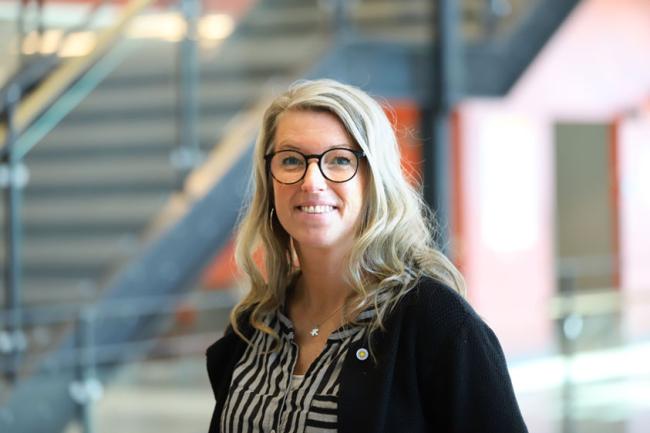
"Loneliness is not only about who you live with or how many people you meet," says Malin Knutz, researcher in public health science at Karlstad University. "And young adults stand out in our study."
Many people experience loneliness despite not living alone. This is one of the key findings of a new study conducted by Karlstad University and Region Värmland. The researchers also found that young adults report the highest levels of both loneliness and poor mental well-being.
The study is based on responses from more than 6,300 residents of Värmland aged 18 to 90 who participated in the regional public health survey in 2022. The research was carried out by researchers at Region Värmland in collaboration with the subject area of public health science at Karlstad University.
“Perhaps the most surprising finding was that loneliness was about equally common, and in fact slightly more common, among people living with someone than among those living alone. This shows that loneliness is far more complex than simply being physically alone,” says Malin Knutz, researcher in public health science at Karlstad University.
The researchers examined the relationship between loneliness, living arrangements, and mental well-being. Overall, just over one in five respondents reported feeling lonely.
Loneliness Is About More Than Physical Presence
According to Malin Knutz, the findings highlight the difference between having people around you and feeling socially and emotionally connected.
“Loneliness is not only about who you live with or how many people you meet. It is also about feeling understood, seen, and experiencing meaningful social connection. You can be in a relationship and still feel lonely,” she says.
The study also found that individuals who experienced loneliness were more likely to report poorer mental well-being, regardless of whether they lived alone or with someone else.
Young Adults Stand Out
Loneliness is often associated with older age, but the study shows that it affects people across all age groups. Another notable finding is that young adults aged 18 to 29 reported the highest levels of both loneliness and poor mental health.
“It is easy to assume that young people, with their whole future ahead of them and often extensive social networks, should be doing well. But our findings suggest otherwise,” says Malin Knutz.
The researchers accounted for a range of factors in their analyses, including educational attainment, financial difficulties, social support, alcohol consumption, and chronic illness. Even after controlling for these factors, the association between loneliness, living arrangements, and poorer mental well-being remained.
“This study cannot tell us exactly why young adults experience higher levels of loneliness. However, the results show that loneliness cannot be explained solely by economic or social factors. There appears to be something more, related to relationships, belonging, and feeling acknowledged in everyday life.”
Important for Public Health Efforts
Involuntary loneliness is a growing societal challenge that affects both mental well-being and public health. Malin Knutz hopes the study will help raise awareness of the complexity of loneliness, its consequences, and the need for preventive measures. The findings underline the importance of active societal efforts to reduce loneliness and promote mental health.
“Society has a responsibility to recognize the many dimensions of loneliness and to create environments where people can build meaningful relationships,” says Malin Knutz. “A sense of belonging is fundamental to our well-being. Relationships, social networks, community organizations, education, and workplaces all play an important role. People need to feel part of something larger than themselves, to have opportunities to contribute, and to feel that they matter to others.”
Creating contexts where people feel that they belong is an important step, according to Malin Knutz. If she were to summarize the study’s main conclusion in a single sentence, it would be:
“Loneliness is not primarily about being alone; it is about lacking the sense of connection and belonging that people need in order to thrive.”
Read more about the study:
Loneliness, Living Alone and Mental Well-Being: Findings from a Population-Based Study in Sweden
https://journals.sagepub.com/doi/10.1177/14034948261479493
World Mental Health Day Webinar
8 October marks World Mental Health Day. At Karlstad University, the occasion will be observed through the webinar “The Importance of Community and Resilience.”
The webinar is organised by the subject area of psychology and will feature researchers, students, and alumni sharing knowledge, research findings, and personal experiences. The event is free of charge and open to everyone.
When: 8 October, 5:00 PM-7:00 PM (CET)
Where: Online via Zoom
Link: https://kau-se.zoom.us/j/65102110409