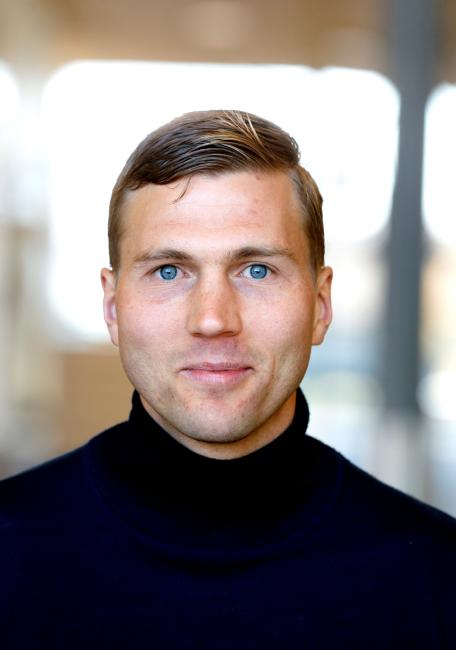
Why is it so difficult to prioritise what is good for us in the long term? In his doctoral thesis, Jonas Hjalmar Blom at Karlstad University explores how our relationship with our future self influences decisions about saving, health, and sustainable consumption.
"I have always been fascinated by our experience of time. The future is uncertain for all of us, and for me that raises questions about what we should do with the time we have," says Jonas Hjalmar Blom, who recently earned a PhD in Psychology at the Service Research Center (CTF) at Karlstad University.
In his thesis, Jonas Hjalmar Blom examines what psychologists refer to as future self-continuity: the strength of the connection between who we are today and who we imagine we will become in the future.
Previous research has shown that people with a stronger connection to their future selves are more likely to save for the future, adopt healthier lifestyles, and experience a greater sense of meaning in life. In his thesis, Jonas Hjalmar Blom investigates whether this connection can be strengthened and what significance it has for the decisions people make.
Your future self can become a friend
In one of the studies, participants completed a simple writing exercise in which they imagined a day ten years into the future and described what their lives looked like. The exercise led participants to experience a stronger sense of connection with their future selves.
"We spend a great deal of time thinking about what will happen in the next hour or next week, but far less time considering what we want our lives to look like in ten or twenty years' time. In many ways, the future self is a stranger we have yet to get to know. By making that person more vivid and getting to know them better, the future self can become a friend we also care about in the present," says Jonas Hjalmar Blom.
Participants who completed the exercise also reported living more in line with their personal values, suggesting that our relationship with our future selves may influence how we think about the choices we make in life.
Easier to influence attitudes than behaviour
The findings show that individuals with a stronger connection to their future selves often hold more long-term and sustainability-oriented attitudes. However, the links between future self-continuity and actual behaviour, such as saving and consumption habits, were considerably weaker.
In one study involving more than 4,000 participants, both survey responses and payment card transaction data were analysed. Participants with a clearer image of their future selves expressed more climate-friendly and financially long-term attitudes, but there were no clear differences in actual savings behaviour.
The results also showed that participants with a stronger connection to their future selves had slightly higher consumption-based carbon emissions than other participants.
"This does not mean that a stronger connection to the future self causes higher emissions. As this was an observational study, we cannot draw conclusions about causality. However, we found that financial resources played a significant role. Individuals with higher incomes consumed more and also had higher emissions," says Jonas Hjalmar Blom.
He emphasises that economic resources often play a greater role in consumption patterns than individual psychological factors.
"The thesis demonstrates that it is possible to influence how people think about the future. However, turning intentions into actions also requires real opportunities and resources," says Jonas Hjalmar Blom.
Knowledge that can support change
The findings may be relevant to anyone seeking to make changes in their lives, whether related to health, personal finance, or sustainable consumption.
"A simple writing exercise will not change someone's life overnight. But becoming more aware of the person you want to be in the future can be a first step towards making decisions that are more closely aligned with your values," says Jonas Hjalmar Blom.
After nearly eight years of work on the thesis, Jonas Hjalmar Blom is looking forward to the next chapter.
"I think I will look back on this period as one of the most eventful and vibrant times in my life. I am proud to have balanced doctoral studies with everything else that life brings," says Jonas Hjalmar Blom. ”The next chapter already awaits, including the publication of a book in Taiwan and Hong Kong.”