Talent development and early selection raise questions that concern the entire youth sports movement. How do we assess potential when young people develop at different rates? What happens to the motivation of those who are selected – and those who are not?
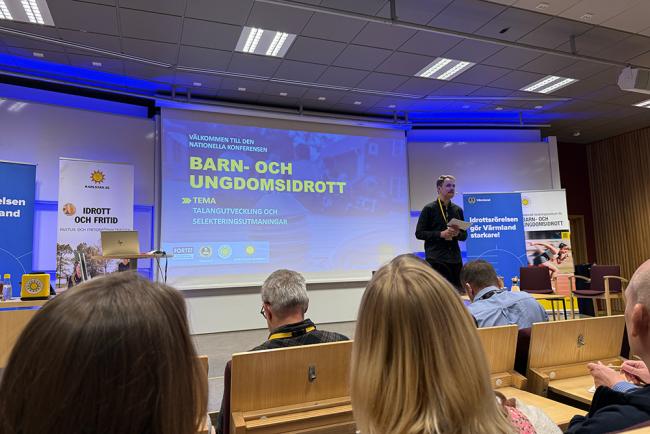
On 20–21 October 2026, the National Research Centre for Youth Sports at Karlstad University hosted a conference that brought together researchers, decision-makers, coaches, and others engaged in youth sports. The event provided an opportunity to exchange experiences, build networks, and discuss how to create development environments where more young people are given the opportunity to grow. Anna Iwarsson, President of the Swedish Sports Confederation (Riksidrottsförbundet) and SISU Sports Educators, opened the conference.
“Sixty-five million times each year, a child in Sweden attends a sports practice session. This is something we should protect and be proud of. In this way, memories for life are created,” said Anna Iwarsson. “We share a responsibility to ensure that sport is fun, developmental, and inclusive for children and young people. Thank you to all the organisers who have brought us together at this conference. We are here to gain new knowledge, share experiences, and explore new perspectives.”
Simon Ruuth, Development Officer for Youth Sports at the Swedish Sports Confederation, served as moderator and echoed Anna Iwarsson’s opening remarks.
“I encourage you to be open to other people’s experiences and to listen with an open mind.”
Not Everything That Glitters Is Gold
The conference featured an extensive programme of presentations interspersed with panel discussions on the topics addressed by the speakers.
The first part of the conference focused on decisions made within sports federations and clubs, and the importance of basing good decisions on sound knowledge from both research and practice. Such decisions should be adapted to the culture, goals, and purpose of the organisation. Rather than simply following trends that have brought success to others, good decisions should be informed by multiple sources and then anchored and approved by the organisation’s board.
Andreas Ivarsson, Professor of Sport Psychology at Halmstad University, reflected on this issue.
“A good decision can save significant resources and be ethically sound, promoting well-being and development when properly evaluated. It is important to remember that sport is about people. What you invest, you get back. It becomes a return on investment.”
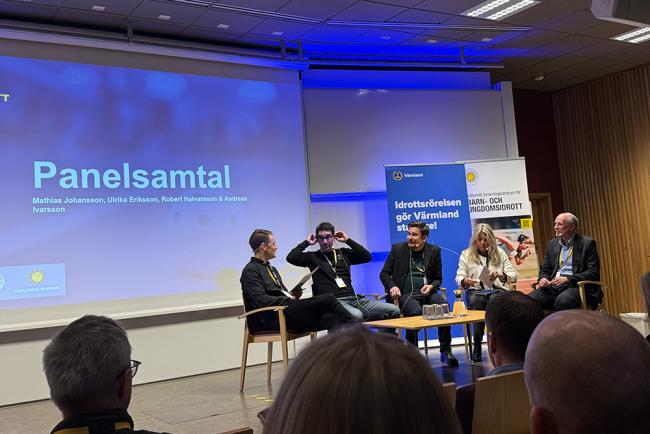
The participants in the subsequent panel discussion were in agreement. Mathias Johansson, Head of Youth Development at Färjestad BK, Ulrika Eriksson, Chair of the Board at Degerfors IF, Robert Halvarsson, Chair of the Culture and Leisure Committee in Karlstad Municipality, and Andreas Ivarsson emphasised the importance of having a clear policy framework within sports organisations and ensuring that decisions are made by the board.
They also discussed the shared educational challenge of allowing children and young people the opportunity to participate in several different sports throughout their upbringing.
Like a Ferrari in the Driveway
This topic led naturally into the day’s next theme: talent development and selection.
How do Swedish sports clubs identify and nurture talent, and how can this be done responsibly without excluding children at an early age?
Krister Hertting, Associate Professor of Education at Halmstad University, presented findings from his research on football academies in Sweden and parents’ perceptions of them.
“This is not only about sporting development. It is also about status, identity, and dreams of future success. Parents invest large amounts of time, money, and commitment in their children’s sporting activities. Securing a place in an academy can be seen as confirmation of both the child’s talent and the parents’ success. Like having a Ferrari in the driveway. At the same time, selection and competition create stress, high costs, and a risk that sport becomes increasingly commercialised. One key conclusion is that the growth of academies reflects a broader social shift in which performance, individualisation, and professionalisation are becoming increasingly important, including within youth sport.”
Anna Fyrberg Yngfalk, Associate Professor at Mälardalen University’s School of Business, Society and Engineering, highlighted similar issues from the perspective of the child.
During the following panel discussion, in which both researchers joined moderator Simon Ruuth, the overarching conclusion was that the sports movement needs to be aware of the impact of commercialisation, actively discuss which values should guide its activities, and continue to safeguard a broad, inclusive, and accessible youth sports system.
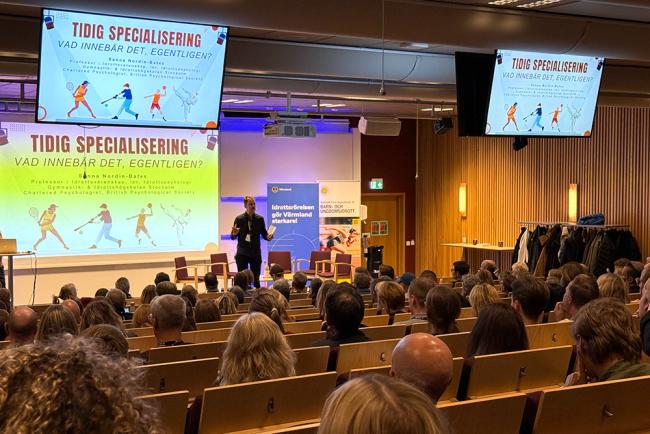
The day continued with presentations from Norwegian researcher Stig Arve Sæther, Professor at the Norwegian University of Science and Technology (NTNU), who shared studies on successful youth sport development environments, and Professor Sanna Nordin-Bates from the Swedish School of Sport and Health Sciences (GIH), who spoke about early specialisation, where children focus exclusively on a single sport before approximately the age of 12 and train intensively throughout most of the year.
Tuesday concluded with a panel discussion on the topic, joined by Canadian researcher Jean Côté, Professor at Queen’s University.
A New Perspective on Talent Development in Sport
The Wednesday programme began with a presentation by Tommy Lundberg, newly appointed Head of Science at the Swedish Football Association, on the organisation’s approach to talent development.
Lundberg previously served as Associate Professor of Physiology at Karolinska Institutet and has published numerous scientific articles on athletic development among children and young people. He regularly lectures on contemporary talent systems and presented the Swedish Football Association’s new perspective on youth football and talent development.
Andreas Linderyd, Head of Research and Development at the Swedish Sports Confederation, followed by discussing the Confederation’s research anthology on development environments.
The conference concluded with a presentation by Professor Jean Côté of Queen’s University, Canada, one of the world’s leading researchers in youth sport and talent development.
His lecture, entitled From Exposure to Engagement: Understanding the Importance of Interest in Youth Sport Development, presented research identifying three key triggers for developing interest: supportive environments, personal engagement in a variety of activities, and high-quality social relationships.
“Coaches, leaders, and researchers are therefore encouraged to broaden their focus beyond long-term performance goals and also promote the experiences in the moment that build the interest required for sustainable participation and well-rounded athletic development among young people.”
The statement neatly summarised the first conference organised by the National Research Centre for Youth Sports at Karlstad University.
“What a remarkable mobilisation for youth sport we achieved here in Karlstad,” said Henrik Gustafsson, Professor of Sport Science and Scientific Director of the National Research Centre for Youth Sports at Karlstad University. “With a fully booked conference and strong engagement from representatives of sport federations, clubs, RF-SISU districts, and decision-makers from across the country, I am taking valuable conversations and renewed energy with me into the continued work of bringing research and practice closer together.”
The conference was funded by Forte and organised in collaboration between Karlstad University, RF-SISU Värmland, and Karlstad Municipality.