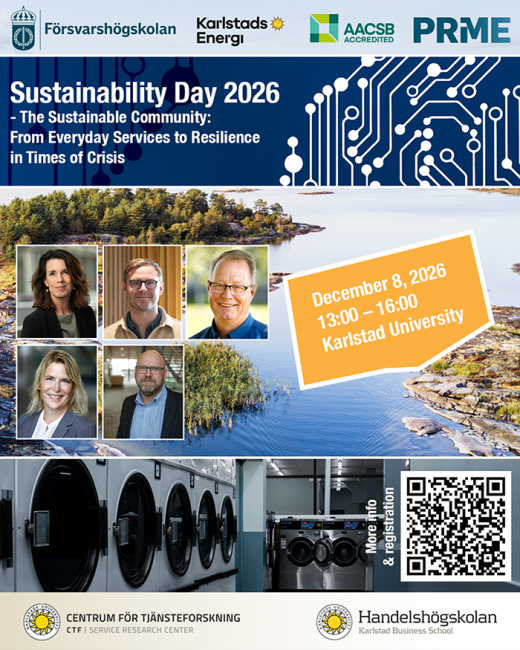

Students, colleagues and everyone with an interest are warmly welcome to Sustainability Day 2026 at Karlstad University, a hybrid event hosted by Karlstad Business School and the Service Research Center (CTF).
This year's theme, The Sustainable Community: From Everyday Services to Resilience in Crisis, looks at how the premises and environments we use in everyday life can also give society capability and resilience in times of crisis. "A shelter that only opens once a crisis has already struck is somewhere we first have to find and get to know.
– The environments that work best when something unexpected happens are often the places we already know, use and feel safe in, says Samuel Petros Sebhatu, Associate Professor of Business Administration and moderator of the day.
By adapting and reusing existing environments as needs change, we can use resources more efficiently, reduce the need for new construction, and create places that are both more resilient and more sustainable than those designed for a single, static purpose. How do we build communities that can withstand crises without losing what makes them vibrant in everyday life? And what responsibility do we each have for contributing to that preparedness? These are the questions we want to discuss.
When everyday life becomes preparedness
Ask someone in London, or in many other European cities, what role the individual plays in national security, and you are likely to be met with a puzzled look. In Sweden, the answer often involves home preparedness: stored water, a wind-up radio and the well-known brochure sent to every household. But is that enough? Keynote speaker Abigail Choate, Director of the Centre for Societal Security at the Swedish Defence University, has long followed the development of Swedish preparedness and has worked on issues such as community safety points and civil defence.
– Much of what we prepare for, such as power cuts or infrastructure being temporarily knocked out, can be caused by natural events or human error, says Abigail Choate. But the ability to handle such events is also what makes us ready for the worst-case scenario: heightened alert or war.
Leadership is a key dimension. What does today's security situation demand of politicians, university leaders, municipal executives and other decision-makers?
– Anyone who worked on these issues in a municipality in 2015 has a job with completely different content today. Decision-makers need to be proactive and ready to act. Sooner or later, we also arrive at the big questions: What are we prepared to defend? What are we prepared to sacrifice to protect democracy? That is where conversations about courage and will become most interesting. Collaboration between the private and public sectors as drivers of preparedness is also absolutely crucial.
Preparedness as a business opportunity
How do we build robust communities while also creating business value? That is the question Karlstads Energi will address in its keynote in the afternoon. David Bohn Stoltz, Head of Unit, and Anders Skoglund, Business Developer in the Power Trading and Business Development unit, will discuss the energy company's role in total defence and the opportunities that come with the energy transition, for example in solar power, battery storage and ancillary services.
– As an energy company, we have a clear responsibility if a crisis occurs, says David Bohn Stoltz. At the same time, much of what strengthens our resilience also consists of solutions that work extremely well in everyday life and create value. It is precisely that combination that makes the issue so interesting.
The laundry room as a safety point and community hub
In the research project The Laundry Room as a Community Hub, Karlstad Business School is working with the Municipality of Karlstad, Karlstads Bostads AB, Grunditz Göransson Arkitekter and Karlstads Energi to explore how an ordinary shared laundry room can take on an entirely new meaning. In everyday life, it is a place where people meet. In a crisis, it can become a safety point where residents can get information, warmth, a place to charge their devices and access to water. It can also be the place where someone notices that a neighbour has not been seen for several days.
During the morning, students on the course Responsible Management and Leadership will work on twelve ethical dilemmas drawn from the project as cases, together with representatives from organisations including Karlstads Bostads AB.
– The students are working with real challenges from a project that is under way here and now in Karlstad, says Sara Davoudi, Senior Lecturer in Business Administration and course coordinator.
The students face questions with no easy answers: Whose medicines should be kept refrigerated when there isn't enough electricity for everyone? Should there be a register of people with particular health needs? Could private electric cars be used as shared batteries in a crisis? The results will be presented as posters and discussed with the students during the coffee break at Sustainability Day.
– Every conclusion must be justified with support from research or from the case itself. The students must also identify the strongest counterargument. That is considerably more challenging than simply expressing an opinion, but also far more valuable, says Sara Davoudi.
From research to the solutions of the future
Mikael Johnson, Senior Lecturer in Business Administration and researcher at CTF, will talk about community resilience in terms of the relationships between people, organisations and resources. A service perspective reveals how coordination, trust and the ability to mobilise shared resources can strengthen both everyday sustainability and society's capacity to handle crises.
Helén Williams, Associate Professor of Environmental and Energy Systems and researcher at CTF, will turn our attention to something as fundamental as food. Drawing on research into food waste, school meals and local food supply, she will show how our relationship with food, people and place can strengthen our commitment to protecting the resources we share, ultimately a question of caring for society's long-term sustainability and resilience. The day concludes with some reflections on living labs as a method where researchers, students, businesses and community actors can develop and test solutions together in real-world settings.
Sustainability Day will be held in English.