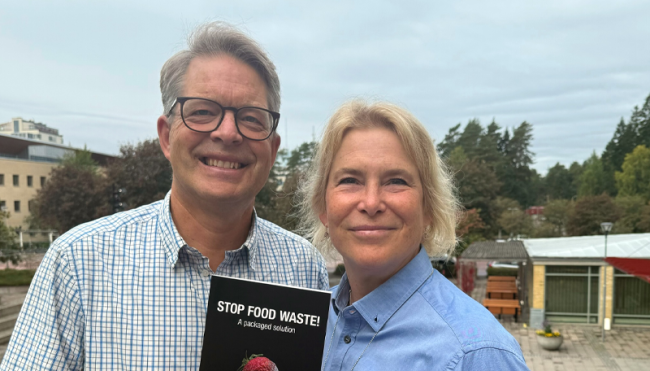

– Without packaging, food waste would increase dramatically, say researchers Fredrik Wikström and Helén Williams at the Service Research Center (CTF) at Karlstad University.
29 September is International Day of Awareness of Food Loss and Waste. As global interest in conserving resources continues to grow, researchers Fredrik Wikström and Helén Williams have now seen their book Stop Food Waste translated into English. Through the book, they aim to highlight the importance of viewing the entire product system, not just the food itself.
– Today, efforts to reduce the environmental impact of packaging and efforts to reduce food waste are often carried out separately, says Helén Williams, Associate Professor of Environmental and Energy Systems. We want people to look at the product as a whole and try to minimize its overall environmental impact. This makes it important that packaging helps consumers waste less food and that it is easy to recycle.
– We also want to draw attention to advances in packaging technology that make it possible to keep food fresh all year round, says Fredrik Wikström, Professor of Environmental and Energy Systems. These services are often taken for granted today, and many people see packaging as an environmental villain that should simply be removed. But without packaging, food waste would increase dramatically. That is why it is so important to minimize the environmental impact of the entire product, rather than considering food and packaging separately.
Do you see growing global interest in the issue of food waste?
– Yes, interest in reducing food waste is strong in many parts of the world because the environmental impact of food production is so significant, says Helén Williams. It is also a concrete target within the UN’s Agenda 2030, but we are still far from achieving the goal of halving food waste.
Research clearly shows that packaging design and the amount of food contained in a package affect how much food is discarded. The two most important factors are the quantity of food in the package and misunderstandings surrounding date labeling.
– If we buy more food than we can eat in time, the excess is often thrown away either because it spoils or because the best-before date has passed, says Helén Williams. Many consumers still believe that food cannot be eaten after that date. Package size is particularly important because the number of small households has increased significantly over recent decades, while larger package formats have become more common in order to lower unit prices.
– It is important to choose the right package size and not be tempted solely by lower unit prices, says Fredrik Wikström. Cheap can become expensive if part of the contents ends up being thrown away.
What should consumers keep in mind if they want to reduce food waste?
– Our best advice is to spend one week keeping track of what is thrown away at home, says Helén Williams. Our studies show that once people become aware of what they waste, many change their behavior and, for example, plan their shopping more carefully.
How can people set a good example for children, young adults, and others?
– Quite simply by talking about the importance of reducing food waste and showing respect for food, says Fredrik Wikström. But also by taking action, and talking about those actions, to minimize food waste. It is especially important to explain the meaning of date labeling so that people do not throw away food simply because the best-before date has passed.
What impact would you like the book Stop Food Waste to have?
– We hope to reach a broader international audience beyond academia, says Helén Williams. Legislation, for example within the EU, needs to change so that packaging’s role in reducing food waste is taken into account, rather than regulating packaging solely as a product in its own right.
– If the goal is to minimize a product’s overall environmental impact, foods with a high environmental footprint may need to be sold in smaller package sizes to reduce waste, even if that results in greater use of packaging materials, says Fredrik Wikström. On the other hand, some packaging used for products with a low environmental impact can certainly be questioned. Does it really make sense to package water in plastic bottles, or should refill systems be used instead?