Crises Lenses: Extending Cross-Border Crisis Training into VR is a part of INCREDILAB and make training for floods, wildfires and other large-scale events that demand coordination between regions, organisations and stakeholders possible.
– Building that coordination before a real crisis occurs is both difficult and essential, says Ala Sarah Alaqra, docent in information systems at Karlstad Business School.
Crisis Lenses is a virtual reality (VR) training game developed within INcreased Climate Resilience Education and DIgital transformation Lab project (INCREDILAB).
– Crises Lenses is built on our joint work in the project of the board game Collaborate or Collapse, which was designed to support collaborative decision-making in cross-border crisis scenarios, says Ala Sarah Alaqra. While the board game encourages structured discussion around a table, Crisis Lenses explores how immersive digital environments can add new dimensions to learning and training.
The work on Crisis Lenses has so far focused on defining the technical and design foundations of the VR training. A central task has been to translate the collaborative core of the board game into a digital environment without losing its emphasis on dialogue, joint decision-making and reflection.
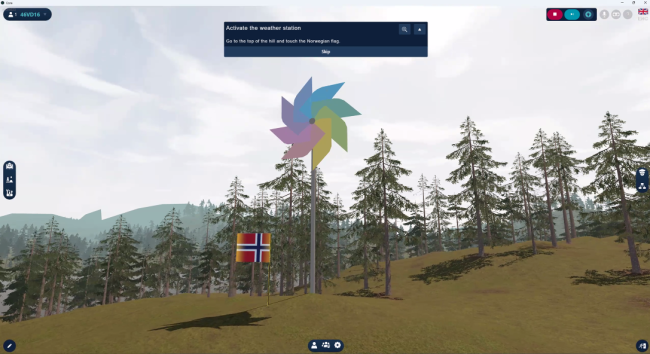
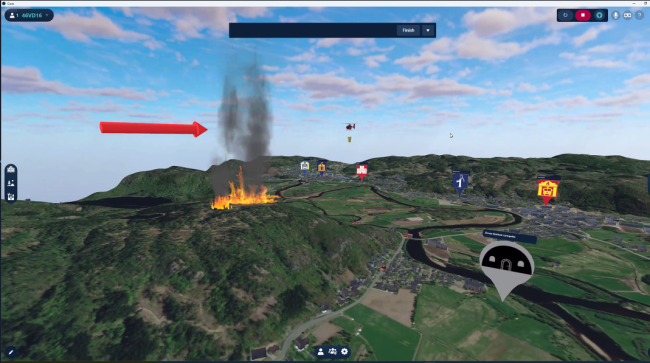
– Using VR technology provided by FyndReality, the team has explored and tested a range of technical and design elements within the platform, says Ala Sarah Alaqra. This includes prototyping visual effects such as dynamic fire and environmental features, experimenting with different spatial designs, and testing how discussion sessions can be integrated directly into the virtual environment.
The design process has shown that immersive technology offers opportunities, but also constraints. Technical feasibility, usability and learning objectives must be carefully balanced.
– Based on the work so far, we have a clearer understanding of what the platform can support and how interaction should be structured to maintain a collaborative focus rather than a purely game-driven one, says Ala Sarah Alaqra.
The project is currently refining several alternative design solutions and continuing to evaluate selected gaming elements. The next stage will involve increasing the fidelity of the prototype, both visually and functionally, together with the fully functioning game scenario.
– Upcoming evaluations will relevant stakeholders from municipalities and regional authorities from both Värmland (Sweden) and Innlandet (Norway), says Ala Sarah Alaqra. These tests will help assess the practical relevance of Crisis Lenses as a tool for strengthening collaboration, coordination and joint decision-making in real cross-border crisis contexts.
Crises Lenses: Extending Cross-Border Crisis Training into VR also includes Geir Ove Venemyr, Universitetslektor in Universitetet i Innlandet and Kristine Kvam, CTO, FyndReality.