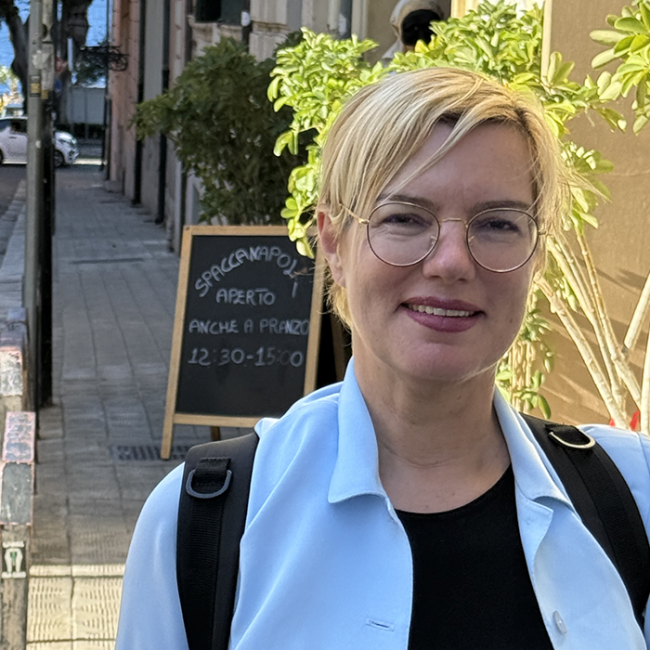

– I would like to gain a deeper, contextually grounded understanding of how personal assistance is legally regulated and applied in Sweden, says Manja Kreševič.
Why did you select Karlstad Business School for your research study visit?
– My decision to undertake a research visit at Karlstad Business School was driven by both my broader academic focus on Sweden and the relevance of its model to my PhD studies. My research examines the legal framework for personal assistance in Slovenia, with a comparative perspective on Sweden, widely seen as a pioneer in this field through its 1994 LSS legislation.
– Karlstad Business School was also a natural choice given its collaboration with my home institution, the University of Maribor, and its strong commitment to societally relevant, interdisciplinary research aligned with my socio-legal approach.
Tell us about the academic value of your visit
– It lies in gaining a deeper, contextually grounded understanding of how personal assistance is legally regulated and applied in Sweden. A key aim is to identify elements of the Swedish model that could help strengthen the Slovenian framework and address existing legislative gaps. This comparative perspective will be central to my PhD research and its proposed recommendations. In addition, engaging with students and faculty at Karlstad Business School will provide valuable insights from a different academic environment.
Slovenia and Maribor – in what way would our outgoing students choose this destination?
– Maribor, Slovenia’s second-largest city, shares much with Karlstad – both are welcoming, human-scaled university cities offering a high quality of life. With around 95,000 inhabitants, Maribor combines a lively cultural and academic scene with a compact, walkable centre and a strong sense of community.
– The city is closely connected to nature, surrounded by vineyards and the Pohorje mountains, which offer year-round outdoor activities. It is also home to the world’s oldest grapevine and sits at the heart of the Štajerska region, recently ranked among Europe’s top destinations. Like Karlstad, Maribor enjoys many sunny days, contributing to student well-being.
– Above all, Maribor is shaped by its university, whose vibrant academic environment and international community give the city a dynamic, student-centred character – much like Karlstad.
How did funding through Erasmus+ make your visit possible?
– The financial support provided through the Erasmus+ programme has been a decisive factor in enabling my research study visit to Karlstad Business School. I would also take the opportunity to encourage fellow PhD and other students and researchers who may still be deliberating whether to pursue an Erasmus+ experience not to hesitate, and to make full use of the opportunities available to them. Such experiences are not only academically enriching but also of immeasurable personal value, offering the opportunity to engage with different cultures, to encounter new people and places.
Tell us about your research
– My PhD research advances a central thesis: that the existing legislative framework governing personal assistance in the Republic of Slovenia does not give sufficient consideration to the position of the personal assistant as a worker within the social care system, nor does it adequately address the full range of needs of users of personal assistance services.
– The research demonstrates that, notwithstanding the progressive nature of the Slovenian personal assistance model; recognised by the European Network on Independent Living (ENIL) as among the most adequate in the European Union; significant systemic deficiencies persist. Personal assistants remain inadequately remunerated in comparison with professionals in related occupations, their occupation has not been formally established within the public sector remuneration framework, and the legislative provisions governing training, the scope of services, and the use of modern technology require further development and specification.
– A comparative analysis of the legal frameworks of the Republic of Slovenia and the Kingdom of Sweden reveals both structural parallels and substantive differences, particularly with regard to the direct financing of personal assistance, the involvement of family members as personal assistants, and the scale of implementation. The research further identifies challenges relating to uneven regional accessibility of services, staff turnover, and the adequacy of existing legislative provisions in practice in Slovenia.
– The research concludes that systemic legislative reform is imperative in order to ensure fair remuneration for personal assistants, to professionalise the occupation, and to guarantee the full realisation of the rights of persons with disabilities to independent living and inclusion in the community, in accordance with Article 19 of the United Nations Convention on the Rights of Persons with Disabilities.