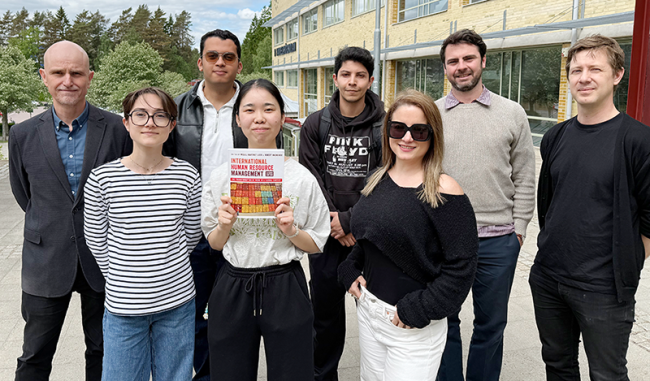

A global subject, a global classroom and a global team of academics with global teaching materials together create the perfect conditions for education with an international reach. At Karlstad Business School, the course Human resource management in a global context has just been completed.
In a world where borders are blurred by digitalisation, migration and the global economy, the need for education with global content has never been greater – for both students and employers.
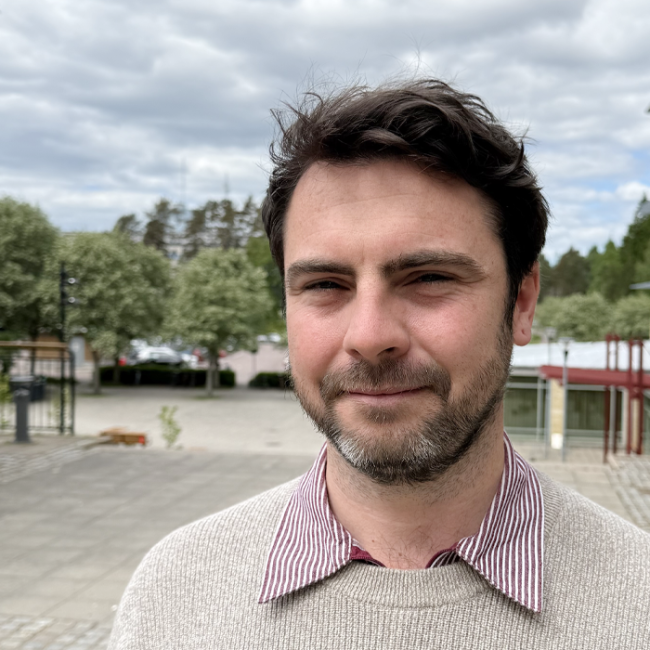
– A global perspective in teaching is not just about including examples from different parts of the world – it is about developing the ability to understand, collaborate and act in complex, multicultural contexts, says Robert MacKenzie, Professor of working life science at Karlstad Business School and joint course leader.
– The course is offered both to students on the working life bachelor programme and incoming exchange students from Karlstad University’s exchange partner universities around the world.
For the students, this has been an opportunity to learn about issues of work and employment in a global context. Aspects such as sustainability, gender, diversity, technological development, changing global relations and the potential role of HR are included. For employers, it means access to employees who can navigate international environments, handle global challenges, and contribute to innovation.
– To integrate global content in education is no longer optional – it is a necessity for preparing both individuals and organisations for the future, says David Regin Öborn, joint course leader and lecturer in working life science at Karlstad Business School.
The course has been built around a textbook co-written and edited by Robert MacKenzie and Professor Miguel Martinez Lucio, University of Manchester. The book “International Human Resource Management: The Transformation of Work in a Global Context” draws together research from an international team of academics who tackle a broad range of issues associated with globalisation and its impact on multinational companies and employees.
During the course, authors from the book such as Dr. Chris McLachlan, Senior Lecturer in HRM, Queen Mary University of London come to Karlstad to teach the students about their specialist area.
– My chapter deals with redundancy – that is, when people lose their jobs. One of the chapter’s main aims is to examine what job loss means and what consequences it has for the individual. It is also about highlighting the different ways companies, governments, and trade unions support workers who have lost their jobs. I look at the interaction between these actors, how well it works, and try to identify what it means at a national level, since different countries have different systems and approaches.
– It concerns how institutions are organised when it comes to support – whether they work proactively or reactively – and trying to understand which national conditions make workers feel supported when they lose their jobs.
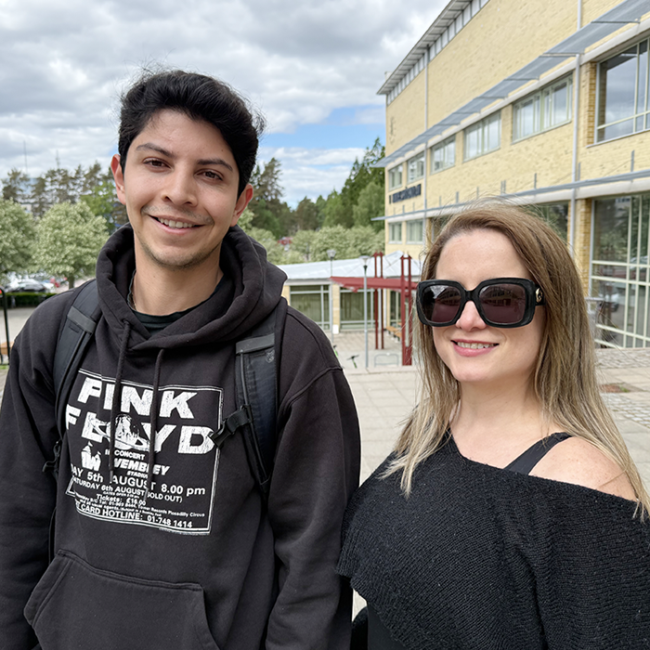
Students Brian Paul (University of Guadalajara) and Catherine Leah (Karlstad University) are both pleased with the course, which gave them the opportunity to be taught by the authors themselves.
– As a student, you get a first-hand perspective and with that a deeper and better understanding, says Brian Paul. It is also easier to ask questions when you have the author in the classroom.
– As a student, you get specific information directly from the author, says Catherine Leah. It is also valuable to be able to place the information in a global context – we gain an international perspective on how companies operate.
Both are very satisfied with the education they have received at Karlstad Business School.
– I think Karlstad Business School is unique, says Catherine Leah. Academically, it has been a very rewarding and positive experience. The students are knowledgeable and it is clear that the programme at Karlstad Business School are of high quality – and it also feels international.
Brian Paul is enthusiastic about his time at the Business School.
– My experience has been fantastic because I have met academics from different parts of the world – which has given me a broader knowledge perspective. I think that is incredibly important because it helps you understand different subjects better. The international mix is truly positive.
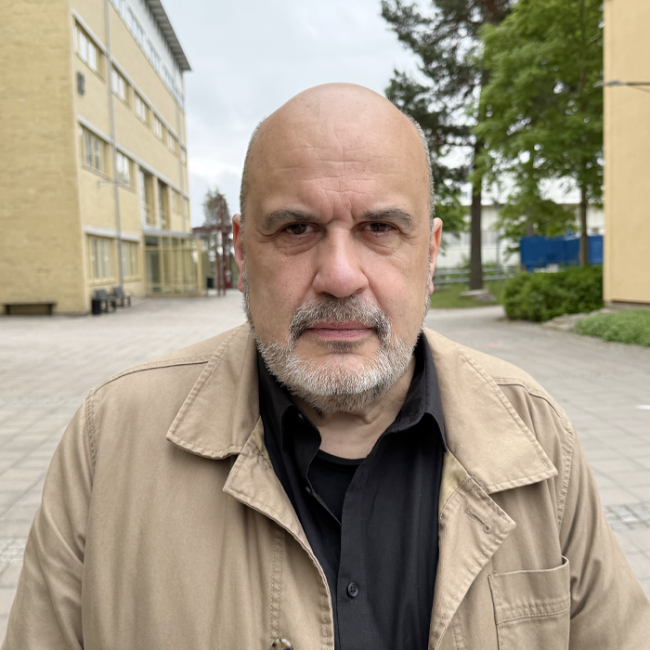
Professor Miguel Martinez Lucio, co-author and editor, also visited Karlstad to teach the materials he authored himself.
– I think it is important to come here and teach in person – especially in a country like Sweden, where there is a very interesting system for labour relations and a strong tradition of labour law, equality, and welfare. Sweden is very diverse, and the students reflect on the things we have written or the perspectives and developments that exist regarding different strategies. It is also rewarding for us who come with a British perspective, where the system looks a bit different. It has truly been enjoyable to meet the students at Karlstad Business School.
Chris McLachlan agrees.
– It has been very positive to teach at Karlstad Business School. One of the things I appreciate is that we were invited to teach a specific chapter. Having the time to focus solely on one chapter – which I also wrote myself – is in a way a luxury. There is also an international dimension at Karlstad Business School, with students studying an international subject. I also learn myself – when you write, you capture a moment in time, and afterwards you have had time to think more about the subject. That is why I have been able to update and further develop the content.
The course leaders are continuing to develop Human resource management in a global context, building on the international networks at the heart of the book including the possibility of developing links between students on an international basis through global classrooms with universities in the UK.