WoodVALOR
WoodVALOR addresses the challenge of recycling of contaminated wood in the context of biorefinery, by developing customized solutions for wood decontamination while ensuring recovery of metals and treatment of decontamination liquids to have a zero-waste approach and introduce circularity to the process.
WoodVALOR Consortium
The WoodVALOR consortium consists of 11 partners from 6 different countries. The project unites industry leaders, SMEs, and research institutes to develop sustainable technologies that convert contaminated wastewater into valuable bio-based products, fostering a circular bioeconomy.
Karlstad University's role within the project
The project consists of seven work packages of which Karlstad University is leading one focusing on sustainability assessments, Techno Economic Analysis (TEA), Life Cycle Assessment (LCA), and Social LCA (S-LCA) studies contributing to the development of a deadwood valorisation support system. WoodVALOR is embedded in Karlstad University’s Pro2BE research environment, focused on sustainable bioeconomy processes and products. The KAU team for environmental and energy systems contributes expertise in system analysis of wood-based biomass processing.
Project period
June 2025 - June 2028
Funding
This project was co-funded by the European Union through Horizon Europe Joint Undertaking Research and Innovation Actions under the programme Circular Bio-based Europe Joint Undertaking (Grant ID: 101214964).
Project abstract
Contaminated wood often has altered physical properties and a higher risk of leaching harmful substances which increases environmental risks and limits recycling options, requiring careful disposal or treatment to prevent toxic exposure to humans and ecosystems. The processes developed in the project for the valorization of contaminated wood waste will take a safe and sustainable by design approach to ensure safety of the process and no release of toxic chemicals into the environment.
The processes will use green approaches for decontamination and subsequent valorization via two routes and in an integrated process: (1) Thermal conversion to biochar for its application in heavy metal recovery and remediation of contaminated land; and (2) Deconstruction and transformation through chemical and biological means to produce chemicals and materials for use in the paints & coatings and construction industry sectors.
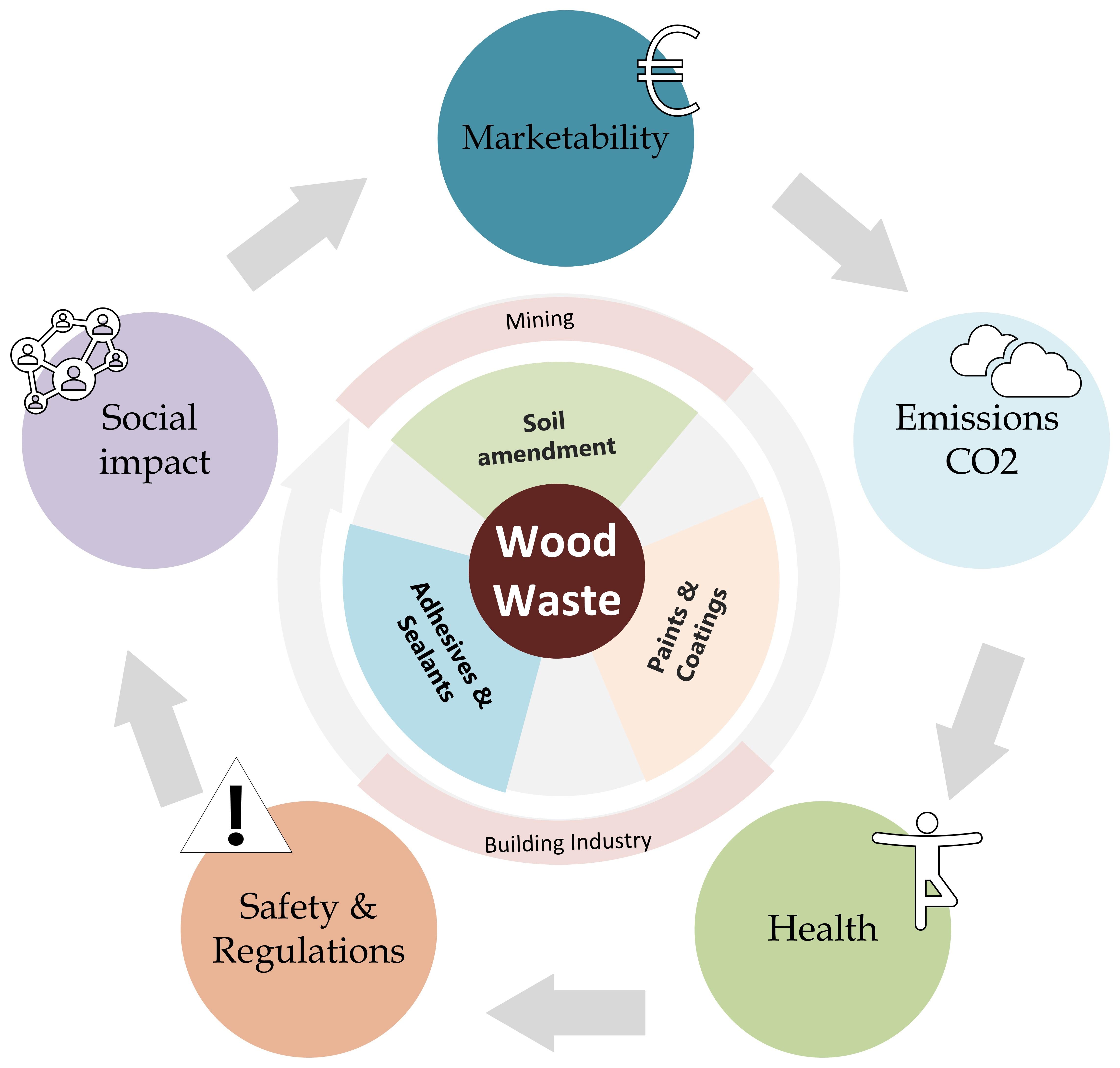
Conceptual overview of the KAU sub-project within the WoodVALOR project
In this project, Karlstad University focuses on the development of a decision support system (DSS) based on a superstructure/mathematical modelling to determine the most sustainable biorefining pathway of wood waste for chemicals, nutrients and material recovery. Different tools and indicators will be taken into account to address environmental constrains, techno-economic capacity and societal acceptance of the developed products. For building the DSS platform, different methodologies at advanced level including LCA, TEA, Planetary Boundaries, and S-LCA will be applied in the project. The DSS will operationalize the knowledge developed in the consortium and make it possible to make qualified analyses beyond the horizon of the chemical value chains. This approach will allow the project to answer the following questions:
(1) Are biobased chemicals for paints & coatings, adhesives, and sealants sustainable strategies to manage wood waste from environmental, social, health and economic perspectives?
(2) Among considered technologies, which scenario is the most sustainable biorefining pathway for valorizing wood waste into acrylic acid, low molecular weight binders and biochar from a value chain context?